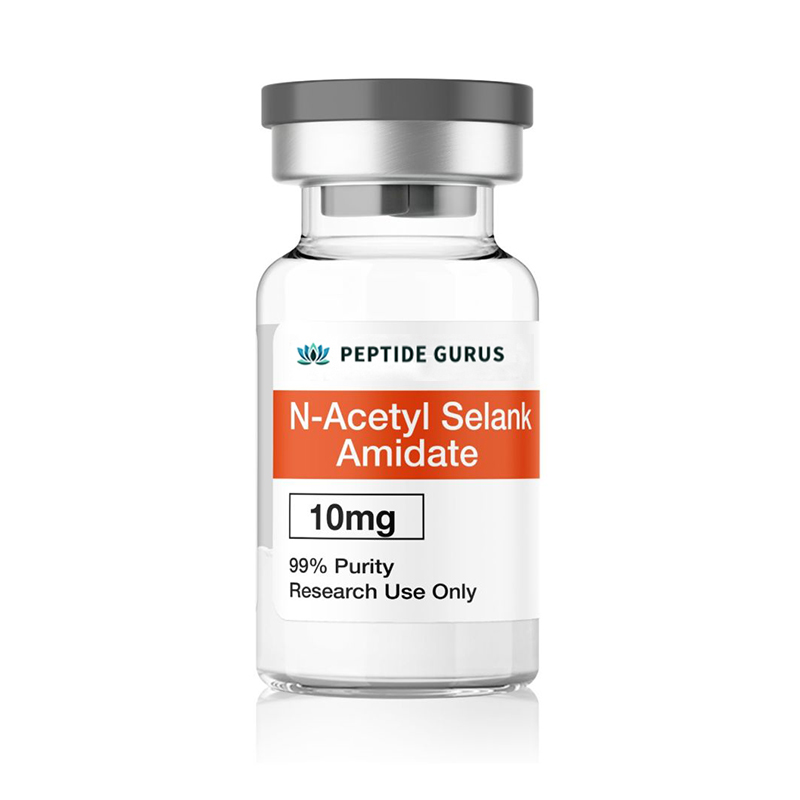
n-アセチルselank amidate
N-AcetylSelankAmidate is a modified form of the peptide Selank. Selank is a short nootropic and anxiolytic peptide originally developed in Russia. It is an analogue of naturally occurring tuftsin and has been shown to have immunomodulatory effects. Research suggests that Selank modifies gene expression in the brain, reducing the effects of the neurotransmitter GABA, altering cell membrane permeability, and enhancing production of brain-derived neurotrophic factor (BDNF).
The modified form of Selank, N-Acetyl Selank Amidate has a longer half-life and greater ability to cross the blood-brain barrier. It also has tighter receptor binding due to the amidation. Selank is currently being researched in animal models for the treatment of stroke and other ischemic brain diseases. It is also under consideration as a treatment of generalized anxiety disorder and to protect memory in the setting of neurodegenerative disease.
n-アセチルselank amidateおよびdna
Selankには、特に中枢神経系において、科学者にとって興味深いいくつかの効果があります。 Anastasiya Volkova博士(ロシアの分子遺伝学研究所)の研究は、Selankが遺伝子発現を調節するためにこれらの効果を生成することを示しています。言い換えれば、SelankはDNAの一部をオンまたはオフにして、体の機能に影響を与えることができます。ラットの研究は、Selankが少なくとも52種類の遺伝子の機能を修正することを示しています[1]。
セランクと不安
おそらく、Selankの最も慎重かつ徹底的に研究された財産は、不安を調節する能力です。研究によると、Selankには、深刻な不安障害の治療に使用されるベンゾジアゼピンのような薬物のような臨床効果があることが示されています。 Selankは、不安を効果的に軽減し、ストレスを低下させ、気分を改善することが示されています。 GABAとの相互作用(おそらく間接)を介してそうするようですareceptor, just as benzodiazepines do. It even has similar sedative effects when compared to benzodiazepines.
Where Selank differs from drugs like Ativan and Valium, however, is that it does not appear to be habit-forming. Benzodiazepines have a well-known abuse potential and can cause physical dependence or even lead to addiction. Selank does not appear to have this problem and may, in fact, be useful in helping those who are dependent on benzodiazepines to safely and effectively wean off of them.
Research shows that of the 84 genes linked to GABA, Selank modifies at least 45 of them. As noted above, the effects of Selank on the GABAareceptor are likely indirect. It is thought that Selank, rather than binding to the GABA receptor, instead modifies the affinity of the receptor for its natural ligand and thus helps to reduce anxiety by reducing the effect but not the concentration of natural GABA[1].
Interestingly, Selank and traditional benzodiazepines have been tested in combination. The use of both appears to be more successful in treating certain types of anxiety than the use of either alone. In particular, the combination appears to be very useful in treating the often resistant form of anxiety known as unpredictable chronic mild stress[2].Selankと血液脳の障壁
Selank is a member of the peptide family known as glyprolines. Glyprolines are well known for their regulatory functions in biological systems. In particular, glyprolines are known to exert protective and repair-promoting effects throughout the body[3]. Where their effects are seen is dependent on the amino acid sequence of the specific glyprotein. Some are active in the GI tract or pancreas while others, like Selank, are active in the central nervous system.
In general, the glyproline family has been neglected in research settings. A few traits that are common to these highly stable oligopeptides have been elucidated, however. Perhaps most important in the case of Selank is the ability of glyprolines to penetrate the blood-brain barrier. The blood-brain barrier (BBB) is a formidable amalgamation of cellular and extracellular components that limit the kinds of things that can pass from the general circulation into the central nervous system. Glyprolines more readily penetrate this barrier than most other oligopeptides.N-アセチルSelank Amidateおよび免疫系
According to Dr. Olga Uchakina (Mercer University School of Medicine and Rockefeller Foundation grant recipient), Selank has been shown in animal studies to suppress the production of the inflammatory cytokine IL-6[4]. IL-6 (interleukin-6) is secreted by macrophages as well as by cells of the bone marrow and blood vessels. It is an inflammatory marker of severe COVID-19 infection. IL-6 is an important mediator of fever, neutrophil production, and B cell growth. In the central nervous system, IL-6 plays roles in sleep-associated consolidation of emotional memories and may be important as a mediator of pain perception.
It is as a mediator of pain perception that is of particular interest to researchers looking at IL-6 and Selank interactions. Research in rats suggests that Selank may modulate IL-6 expression in the central nervous system and may therefore help to reduce pain in the so-called asthenic symptoms[5]. It as long been controversial in the medical community whether there is a link between psychiatric conditions and physical pain. The ability of Selank to mitigate physical pain in psychiatric conditions seems to point to the accuracy of the hypothesis and offers a solution at the same time. It is unclear at present whether Selank might offer relief from other types of neurogenic pain. Future research could help to uncover a role of glyprolines as regulators of pain generated by the nervous system, and thus help scientists to better understand how to treat and control neuropathic pain.抗凝固剤としてselank
Much research has been performed on the role of Selank in treatment and recovery of ischemic brain disease. Much of this research has focused on the role of Selank as a gene regulator and on its ability to enhance the process of neurogenesis. As it turns out, Selank may have other potential benefits in the setting of ischemic brain disease as well.
Animal studies have revealed that Selank (and Semax) can help to regulate the process of coagulation (blood clotting). Both peptides may help to maintain homeostasis in the coagulation cascade and offset the effects of both hypercoagulation (blood clotting) and, to a lesser extent, bleeding[6], [7]. Selank has shown early promise as an anti-coagulant. Though continued research is needed, this property may make Selank a potential dual therapeutic in the setting of stroke. In this case, it could not only protect neurons against excitotoxic damage, but could protect them from disordered coagulation as well.
Supporting the observations that Selank is beneficial in hypercoagulable states is research in rat mesenteric vessels. This research shows that, in general, can help to prevent the microcirculation hypercoagulation that occurs in mesenteric vessels as a result of immobilization[8]. As such, glyprolines like Selank are of increasing interest for their ability to regulate coagulation cascades in the setting of prolonged immobilization common due to surgery or hospitalization. Blood clots following these cases are currently treated with heparin injections, which can shift the balance too far and lead to bleeding. The ability of Selank and other glyprolines to gently regulate coagulation without overcompensation and causing bleeding makes them very attractive as for the development of blood clot prophylactics.N-アセチルselankは、向知性薬として調整します
No discussion of Selank would be complete without exploring the potential of this peptide to enhance cognition. Extensive research has linked Selank to alterations in gene expression patterns in anxiety and coagulation. Additional research, in rats, reveals that nasal administration of Selank produces changes in mRNA levels for 36 different genes associated with plasma membrane function and ion-dependent learning and memory functions[9].
Rats treated with Selank show increased memory trace stability, which results in greater long-term retention of learning. Additionally, Selank appears to rescue memory and learning following brain damage and can restore cognitive processes in some circumstances. It is though that Selank can inhibit the catecholamine system in the brain, thereby offsetting what is known as excitotoxic neuron death. Excitotoxic neuron death is seen in a wide variety of conditions including head injury, drug overdose, and neurodegenerative diseases like Parkinson’s disease.
Selank administration in rats is associated with increases in levels of BDNF, a chemical messenger in the central nervous system that stimulates the growth and differentiation of neurons. Higher BDNF levels are associated with increased learning, improved memory, and reductions in the effects of neurological injury. Many nootropics have been found to alter BDNF expression patterns in the brain. The ability of N-AcetylSelankAmidateto penetrate the BBB likely makes more readily it a more potent nootropic than standard Selank.N-アセチル化の目的
N-Acetyl Selank Amidate is similar in its effects to Selank, as already discussed, so it begs the question of why go to the trouble of modifying the original compound. N-acetylation is a common modification found in natural peptides, particularly peptides in eukaryotes. In fact, most proteins in our bodies are N-acetylated. In yeast and humans, N-acetylation has multiple roles including
In synthetic chemistry, N-acetylation is used to alter the charge, hydrophobicity, and size of a protein. This can impact how long the protein lasts, where it localizes to in the body, and what receptors it binds to. In most cases, N-acetylation is done to prolong the half-life of a protein without affecting its overall function[11]. It is a relatively simple process, making it an affordable and well-known mechanism for improving the potency of a peptide.アミドの目的
Amidation is another minor peptide modification, this time to the carboxyl group on the other end of the amino acid chain. Like N-acetylation, amidation is a natural process that occurs in up to half of all known peptides. Amidation makes peptides less sensitive to proteolytic degradation and extends their half-life in the blood stream. Amidated peptides are less sensitive to changes in pH and more easily bind to their receptors. They also bind more tightly to their target receptors, a feature that extends the effects of amidated proteins as compared to their non-amidated counterparts. Oxytocin, thyroid releasing hormone, and vasopressin are natural peptides in which amidation is known to greatly enhance biological activity[12].
In synthetic biology, amidation serves three major functions. First, amidation helps to protect orally administered peptides from the harsh environment in the stomach and GI tract. With a pH of less than 2, the environment of the stomach is a place that many peptides do not survive intact. The presence of an amide group helps proteins to pass through the stomach intact, which lowers the total amount of peptide that needs to be consumed to reach certain concentrations in the bloodstream.
The second reason that most synthetic peptides are amidated is to improve their potency after absorption. Amidated proteins not only survive longer in the bloodstream, they bind more tightly to their target receptors and produce enhanced signaling as a result[12]. This latter fact is particularly important for peptides that are active in the central nervous system, like Selank. Selank, while more effective than most compounds in penetrating the BBB, is still limited in its ability to enter the central nervous system. Having a higher potency allows the effects of the peptide in the CNS to be more robust.
Finally, amidation tends to alter the lipid solubility of a compound. While this isn’t as critical of a function as the two listed above, it is still the case that amidation increases lipid solubility and thus increases the amount of Selank crossing the BBB. So, not only is amidated Selank more potent due to enhanced receptor binding, but more of it also reaches the receptors in the central nervous system. In this case, the single step of amidation provides two distinct benefits that end up being synergistic.N-アセチルSelank Amidate:要約
N-アセチルSelank Amidateは、Selankの拡張バージョンとして最もよく考えられています。 N-アセチルselankは、セランクのあらゆる側面を改善し、その効力、半減期、吸収性、および血液脳の障壁を越える容易さを高めます。これらの特徴は、疾患や外傷から中枢神経系を保護するために動物研究で発見され、不安を軽減し、学習を改善し、記憶を改善し、血液凝固のプロセスを変えるために動物研究で発見されたSelankの効果を高めるのに役立ちます。さらに多くの研究が行われていますが、Selankや他のグリプロリンは、DNA発現パターンを単一のペプチドによってどのように変化させて劇的な効果を生み出すかについての洞察を提供します。