

Categorías:Péptidos de melanotan
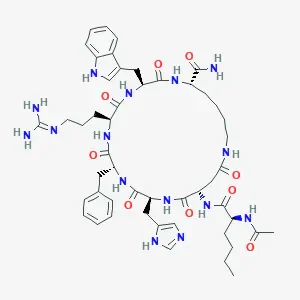 Melanotan 2 InvestigaciónMelanotan 2 y señalización de melanocortina
Melanotan 2 produce sus efectos uniéndose a los receptores de melanocortina. Hay cinco receptores de melanocortina conocidos, cada uno con una función diferente. Se sabe que MT-2 se une principalmente a MC-4R y MC-1R, pero también se une débilmente a MC-3R.
MC-1R: Se encuentra en los melanocitos y la estimulación de MC-1R provoca el oscurecimiento de la piel y el cabello.
MC-2R: Se encuentra en las glándulas suprarrenales y la unión de MC-2R promueve la secreción de hormonas suprarrenales, como el cortisol.
MC-3R: MC-3R participa en el control del apetito y la regulación de la energía, pero se sabe poco más sobre este receptor.
MC-4R: La estimulación de MC-4R provoca cambios en la alimentación y el comportamiento sexual. También afecta la función eréctil masculina y la homeostasis energética.
MC-5R: MC-5R se expresa en las glándulas sudoríparas y las células de los islotes pancreáticos.
Melanotan 2 y el autismo
El hallazgo de la investigación más reciente sobre MT-2 indica que el péptido puede revertir ciertas características autistas en un modelo de ratón de uso común del trastorno del espectro autista (TEA). No existe tratamiento para la afección, pero investigaciones recientes han indicado que la oxitocinterapia puede ser útil para mitigar algunas de los problemas de conducta asociados al TEA. Utilizando un modelo de ratón de activación inmune materna que se sabe que conduce al autismo, los investigadores investigaron si MT2, que se sabe que estimula la liberación de oxitocina, podría contrarrestar el TEA o reducir los comportamientos comunes del TEA. Su investigación reveló que la administración de MT-2 revierte la disminución de la comunicación, la interacción social deteriorada y los comportamientos repetitivos asociados con el autismo en este modelo en particular. De hecho, los investigadores descubrieron que la administración de MT-2 aumentaba la expresión de los receptores de oxitocina en partes específicas del cerebro, lo que sugiere una correlación directa entre la señalización de oxitocina en esas áreas y los comportamientos específicos del TEA[1].
Melanotan 2 InvestigaciónMelanotan 2 y señalización de melanocortina
Melanotan 2 produce sus efectos uniéndose a los receptores de melanocortina. Hay cinco receptores de melanocortina conocidos, cada uno con una función diferente. Se sabe que MT-2 se une principalmente a MC-4R y MC-1R, pero también se une débilmente a MC-3R.
MC-1R: Se encuentra en los melanocitos y la estimulación de MC-1R provoca el oscurecimiento de la piel y el cabello.
MC-2R: Se encuentra en las glándulas suprarrenales y la unión de MC-2R promueve la secreción de hormonas suprarrenales, como el cortisol.
MC-3R: MC-3R participa en el control del apetito y la regulación de la energía, pero se sabe poco más sobre este receptor.
MC-4R: La estimulación de MC-4R provoca cambios en la alimentación y el comportamiento sexual. También afecta la función eréctil masculina y la homeostasis energética.
MC-5R: MC-5R se expresa en las glándulas sudoríparas y las células de los islotes pancreáticos.
Melanotan 2 y el autismo
El hallazgo de la investigación más reciente sobre MT-2 indica que el péptido puede revertir ciertas características autistas en un modelo de ratón de uso común del trastorno del espectro autista (TEA). No existe tratamiento para la afección, pero investigaciones recientes han indicado que la oxitocinterapia puede ser útil para mitigar algunas de los problemas de conducta asociados al TEA. Utilizando un modelo de ratón de activación inmune materna que se sabe que conduce al autismo, los investigadores investigaron si MT2, que se sabe que estimula la liberación de oxitocina, podría contrarrestar el TEA o reducir los comportamientos comunes del TEA. Su investigación reveló que la administración de MT-2 revierte la disminución de la comunicación, la interacción social deteriorada y los comportamientos repetitivos asociados con el autismo en este modelo en particular. De hecho, los investigadores descubrieron que la administración de MT-2 aumentaba la expresión de los receptores de oxitocina en partes específicas del cerebro, lo que sugiere una correlación directa entre la señalización de oxitocina en esas áreas y los comportamientos específicos del TEA[1].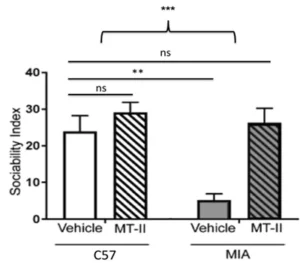 These findings not only suggest potential avenues for developing a treatment for ASDthey have helped to define a specific brain pathway that may be integral to thedevelopment of ASD in the first place. These findings could help scientists develop acomplete model of ASD and thus both treatments and preventative measures.
Melanotan 2 and Hunger
There is good evidence to suggest that MT-2 can reduce fat storage and hunger behaviorin animal models. Researchers have found that the melanocortin-4 receptor (MC-4R)plays a role in food preferences and intake and that MT-2 is a potent agonist of MC-4RAdministration of MT-2 to mice causes significant reductions in how much food theyconsume, but also changes their preference for fatty foods. Mice given MT-2 ignore fattyfoods, which they would otherwise prefer. Similarly, mice devoid of the MC-4R receptorconsume fatty foods almost exclusively and are immune to the effects of MT-2[2].
The effects of MT-2 are similar to those of the hormone leptin, sometimes called thesatiety hormone because it reduces cravings and food intake. Leptin, however, has neverbeen useful in the treatment of obesity, even in individuals who are leptin deficient. This islikely because there are two pathways for satiety, called leptin-dependent and leptin-independent pathways. Research suggests MT-2 is more effective in stimulating bothpathways and thus may be a more effective exogenous treatment for reducing hunger[3], [4]. This latter finding has been bolstered by the discovery that thyrotropin-releasinghormone (TRH) gene expression, which has long been known to play a role in the leptin-satiety pathway, is also affected by MC-4R stimulation[5]. Both MT-2 and leptin arethought to cause an increase in TRH expression in the paraventricular nucleus of thehypothalamus, a region of the brain associated with satiety and food intake, but only MT-2 crosses into the centra nervous system in concentrations hiah enouah to have an effecton TRH expression.
Melanotan 2 and Diabetes
The pathogenesis of diabetes is defined by high blood sugar levels, hypersecretion ofglucagon, and the production of ketone bodiesls. it has been known for some time thatleptin counteracts these factors by increasing the uptake of glucose, suppressingglucagon production, and interfering with the pathway that leads to ketone bodyformation. These actions do not depend on insulin and thus leptin signaling is beingactively investigated as an alternative means by which diabetes miaht be treated
Research has revealed that leptin’s effects on blood sugar are regulated throughmelanocortin receptors and that MT-2 produces similar effects[7]. This is significantbecause leptin has its primary effects in the brain but does not cross the blood-brainbarrier as readily as MT-2. Thus, exogenously administered leptin does not reach theCNS in substantial quantities, a fact that reduces its effectiveness as a drug and handsan advantage to MT-2 even though the effects of the two peptides on melanocortinreceptors are nearly identical.
Melanotan 2, lmpulse Control and Alcohol intake
In keeping with the idea that MT-2 may affect oxytocin signaling and thus behavior inASD, research also reveals that the MC-4R receptor may play a role in impulse controlPast studies in rats have shown that administration of MT-2 reduces alcohol intake andincreases water intake even in rats that prefer alcohol[8]. More recently, research hasrevealed that melanotan-2 works synergistically (boosting efficacy more than seven-fold)with naltrexone to blunt binge-like ethanol intake in mice[9].
These findings not only suggest potential avenues for developing a treatment for ASDthey have helped to define a specific brain pathway that may be integral to thedevelopment of ASD in the first place. These findings could help scientists develop acomplete model of ASD and thus both treatments and preventative measures.
Melanotan 2 and Hunger
There is good evidence to suggest that MT-2 can reduce fat storage and hunger behaviorin animal models. Researchers have found that the melanocortin-4 receptor (MC-4R)plays a role in food preferences and intake and that MT-2 is a potent agonist of MC-4RAdministration of MT-2 to mice causes significant reductions in how much food theyconsume, but also changes their preference for fatty foods. Mice given MT-2 ignore fattyfoods, which they would otherwise prefer. Similarly, mice devoid of the MC-4R receptorconsume fatty foods almost exclusively and are immune to the effects of MT-2[2].
The effects of MT-2 are similar to those of the hormone leptin, sometimes called thesatiety hormone because it reduces cravings and food intake. Leptin, however, has neverbeen useful in the treatment of obesity, even in individuals who are leptin deficient. This islikely because there are two pathways for satiety, called leptin-dependent and leptin-independent pathways. Research suggests MT-2 is more effective in stimulating bothpathways and thus may be a more effective exogenous treatment for reducing hunger[3], [4]. This latter finding has been bolstered by the discovery that thyrotropin-releasinghormone (TRH) gene expression, which has long been known to play a role in the leptin-satiety pathway, is also affected by MC-4R stimulation[5]. Both MT-2 and leptin arethought to cause an increase in TRH expression in the paraventricular nucleus of thehypothalamus, a region of the brain associated with satiety and food intake, but only MT-2 crosses into the centra nervous system in concentrations hiah enouah to have an effecton TRH expression.
Melanotan 2 and Diabetes
The pathogenesis of diabetes is defined by high blood sugar levels, hypersecretion ofglucagon, and the production of ketone bodiesls. it has been known for some time thatleptin counteracts these factors by increasing the uptake of glucose, suppressingglucagon production, and interfering with the pathway that leads to ketone bodyformation. These actions do not depend on insulin and thus leptin signaling is beingactively investigated as an alternative means by which diabetes miaht be treated
Research has revealed that leptin’s effects on blood sugar are regulated throughmelanocortin receptors and that MT-2 produces similar effects[7]. This is significantbecause leptin has its primary effects in the brain but does not cross the blood-brainbarrier as readily as MT-2. Thus, exogenously administered leptin does not reach theCNS in substantial quantities, a fact that reduces its effectiveness as a drug and handsan advantage to MT-2 even though the effects of the two peptides on melanocortinreceptors are nearly identical.
Melanotan 2, lmpulse Control and Alcohol intake
In keeping with the idea that MT-2 may affect oxytocin signaling and thus behavior inASD, research also reveals that the MC-4R receptor may play a role in impulse controlPast studies in rats have shown that administration of MT-2 reduces alcohol intake andincreases water intake even in rats that prefer alcohol[8]. More recently, research hasrevealed that melanotan-2 works synergistically (boosting efficacy more than seven-fold)with naltrexone to blunt binge-like ethanol intake in mice[9].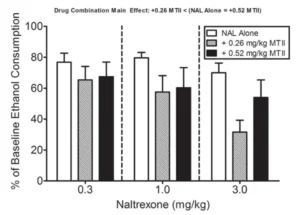 These findings suggest that MT-2 might not only be an effective treatment in alcoholrelated disorders, but that the peptide is tapping into a more fundamental process ofcraving and desire in the mammalian brain. This research may open up pathways to adeeper understanding not just of alcohol abuse and hunger, but the role of oxytocin inimpulsive behavior. lt may even help researchers identify craving pathways and advanceour understanding of human motivation in aspects of life ranging from work torelationships.
Melanotan 2 and Erectile Dysfunction
Erectile dysfunction (ED) is often attributed to vascular issues and can be effectivelytreated in a majority of men via sildenafil (Viagra) and other drugs that improve blood flowby reducing vascular resistance. Not all ED is due to vascular issues, however, and sosildenafil and similar drugs are ineffective in a small percentage of men and in the vastmajority of women who suffer from hypoactive sexual desire disorder. it has long beenknown that MT-2 is an effective treatment for ED, but research suggests that it may havemore wide-ranging application than drugs like sildenafil due to its actions in the centralnervous system. In a study of men who had failed treatment with Viagra, eighty percentresponded to MT-2 treatment[1o]. MT-2 has been actively investigated in the past as atreatment for both male and female sexual desire disorders.
Melanotan 2 lmpacts Wakefulness
We don’t understand a great deal about sleep and arousal, except that the regulation of consciousness is a complicated part of higher brain function. Research has revealed,however, that several different populations of neurons in the brain are critical to differentaspects of arousal such as sleep onset, depth of consciousness, duration of sleep, andmore. The paraventricular nucleus of the hypothalamus is one area of the brain thatregulates arousal in response to stress, social interaction, feeding, and other cues.
Research using mice shows that stimulation with melanotan 2 increases arousal viainteraction with neuronal fibers of the paraventricular nucleus. in fact, stimulation of thispathway can lead to immediate transition to wakefulness from both NREM and REMsleep[13]. Further research in this area may uncover how to improve sleep and enhanceconcentration via the melanocortin system, making peptides like melanotan 2 potentialnootropics.
Melanotan 2 and Alzheimer’s Disease
Past research has shown that activation of pro-opiomelanocortin (POMC)-derivedneuropeptide can rescue some of the synaptic dysfunction that is caused by theneurofibrillary (amyloid) tangles that arise in Alzheimer’s Disease. POMC-derivedneuropeptide can be activated by melanocortin receptors, so mouse models wereemployed to investigate whether melanotan 2 could be useful in this setting. Thisresearch showed that melanotan 2 substantially reduces amyloid accumulation andprominently reduces the A1 subtype of reactive astrocytes. This latter fact is important because Al astrocytes are thought to be a primary driver of neurotoxicity and neurondeath in Alzheimer’s Disease[14]. These findings suggests that melanocortin activationmay be a potential therapeutic target in Alzheimer’s Disease. This represents a novelpathway for investigating Alzheimer’s Disease treatment and may similarly provide ameans of mitigating neurotoxicity in other degenerative brain diseases.
MT-2 Research
MT-2 is a heavily researched peptide, particularly regarding human behavior, sexualdesire, and impulse control. The peptide, in various forms, has been investigated inclinical trials, though problems with routes of administration have forced scientists back tothe drawing board. There is active and ongoing research into the benefits of this particularpeptide.
MT-2 exhibits minimal to moderate side effects, low oral and excellent subcutaneousbioavailability in mice. Per kg dosage in mice does not scale to humans. MT-2 for sale at PEPTIDE GURUS is limited to educational and scientific research only, not for humanconsumption. Only buy MT-2 if you are a licensed researcher.Autor del artículoLa literatura anterior fue investigada, editada y organizada por el Dr. Logan, M.D. El Dr. Logan tiene un doctorado de la Facultad de Medicina de la Universidad Case Western Reserve y una licenciatura en biología molecular.Revista CientíficaAutorEl Dr. Wessells es profesor de la Universidad de Washington, presidente del Departamento de Urología y ha formado parte de varios comités gubernamentales y profesionales nacionales e internacionales, incluidas las Consultas Internacionales de la OMS sobre Disfunción Eréctil y Sexual, un grupo de trabajo del NlDDK sobre complicaciones urológicas de la diabetes y un simposio del NlH. sobre la diabetes. Es cirujano, investigador y experto en traumatismos urogenitales y disfunción eréctil. Sus intereses clínicos incluyen la cirugía reconstructiva del tracto genitourinario, el tratamiento de lesiones agudas y la cirugía compleja para la disfunción sexual masculina. Sus intereses de investigación son la epidemiología y el tratamiento del trauma urogenital; la fisiología y fisiopatología de la disfunción eréctil; cirugía reconstructiva; mecánica de lesiones por accidentes; y complicaciones urológicas de la diabetes. Un agonista proeréctil de la melanocortina desarrollado por el Dr. Wessells y sus colaboradores de la Universidad de Arizona se encuentran en ensayos clínicos para el tratamiento de la disfunción eréctil.
Se hace referencia al Dr. Wessells como uno de los principales científicos involucrados en la investigación y el desarrollo de Melanotan 2. De ninguna manera este médico/científico respalda ni recomienda la compra, venta o uso de este producto por ningún motivo. No existe afiliación o relación, implícita o de otro tipo, entre PEPTIDE GURUS y este médico. El propósito de citar al doctor es reconocer, reconocer y acreditar los exhaustivos esfuerzos de investigación y desarrollo realizados por los científicos que estudian este péptido. DrWessells figura en [11] y [12] bajo las citas a las que se hace referencia.Citas referenciadas1.E,Minakova et al..“Melanotan-l reverses autistic features in a maternal immuneactivation mouse model of autism,” PLoS ONE, vol. 14, no. 1, Jan. 2019. [PubMed]
2.A. van der Klaauw et al.. “Role of melanocortin sianaling in the preference fordietary macronutrients in human beings,” Lancet Lond. Engl., vol. 385 Suppl 1, p.S12.Feb.2015.[PubMed]
3.H.Shimizu, K. Inoue, and M. Mori, “The leptin-dependent and -independentmelanocortin signaling system: regulation of feeding and energy expenditure,” J.Endocrinol., vol.193, no.1,pp.1-9,Apr. 2007.[Research Gate]
4.C.Bigrbaek and A.N. Hollenberg,“Leptin and melanocortin siqnaling in thehypothalamus,”Vitam.Horm., vol.65,pp.281-311,2002.[PubMed]
5.F. Guo, K. Bakal, y, Minokoshi, and A.N,Hollenberg,“Leptin Sianaling Targets theThyrotropin-Releasing Hormone Gene Promoter in Vivo,” Endocrinology, vol. 145.no.5,pp.2221-2227,May 2004.[PubMed]
6.Y. H. Lee, M.-Y. Wang, X.-X. Yu, and R. H. Unger, “Glucagon is the key factor inthe development of diabetes,” Diabetologia, vol.59, no.7,pp.1372-1375, 2016[PubMed]
7.C. Toda et al., “Distinct effects of leptin and a melanocortin receptor agonistinjected into medial hypothalamic nuclei on glucose uptake in peripheral tissues,Diabetes, vol.58,no.12,pp.2757-2765,Dec.2009.[PubMed]
8.D.A. York, S. Boghossian, and M. Park-York, “Melanocortin activity in theamygdala influences alcohol intake,” Pharmacol. Biochem. Behav.. vol. 98. no, 1pp.112-119,Mar.2011.[PubMed]
9.M. Navarro, F. Carvajal, J.M. Lerma-Cabrera, l. Cubero, M. J. Picker, and T. E.Thiele, “Evidence that Melanocortin Receptor Agonist Melanotan-ll SynergisticallyAugments the Ability of Naltrexone to Blunt Binge-Like Ethanol Intake in MaleC57BL/6J Mice,”Alcohol. Clin.Exp.Res., vol. 39, no.8, pp.1425-1433,Aug.2015.[PubMed]
10.”Synthetic melanotropic peptide initiates erections in men with psychogenic erectiledysfunction: double-blind, placebo controlled crossover study. – PubMed – NCBl.”[Onlinel.Available: https://www.ncbi.nlm.nih.gov/pubmed/9679884.[Accessed: 15May-2019].
11.WESSELLS, H. , HRUBY, V. J., HACKETT, J., HAN,G., BALSE-SRINIVASAN, Pand VANDERAH, T. W. (2003), MT-l Induces Penile Erection via Brain and SpinalMechanisms. Annals of the New York Academy of Sciences, 994: 90-95.doi:10.1111/i.1749-6632.2003.tb03166.x
12.Wessells, H.(1998).Synthetic melanotropic peptide initiates erections in men withpsychogenic erectile dysfunction: Doubleblind placebo controlled crossover studyNature.com.Available at: https://www.nature.com/articles/3900371.pdf
13.M.T. lslam et a., “Vasopressin neurons in the paraventricular hypothalamuspromote wakefulness via lateral hypothalamic orexin neurons,” Curr. Biol. CB, ppS0960-9822(22)01121-6,Jul.2022,doi: 10.1016/i.cub.2022.07.020.[PubMed]
14.J.K. Y. Lau et a/., “Melanocortin receptor activation alleviates amyloid pathologyand glial reactivity in an Alzheimer’s disease transgenic mouse model,” Sci. Rep.vol.11,no.1,p.4359,Feb.2021, doi: 10.1038/s41598-021-83932-4.[PubMed]
ALL ARTICLES AND PRODUCT INFORMATION PROVIDED ON THIS WEBSITE AREFOR INFORMATIONAL AND EDUCATIONAL PURPOSES ONLY.
The products offered on this website are furnished for in-vitro studies only. In-vitro studies(Latin: in glass) are performed outside of the body. These products are not medicines ordrugs and have not been approved by the FDA to prevent, treat or cure any medicalcondition, ailment or disease, Bodily introduction of any kind into humans or animals isstrictly forbidden by law.
These findings suggest that MT-2 might not only be an effective treatment in alcoholrelated disorders, but that the peptide is tapping into a more fundamental process ofcraving and desire in the mammalian brain. This research may open up pathways to adeeper understanding not just of alcohol abuse and hunger, but the role of oxytocin inimpulsive behavior. lt may even help researchers identify craving pathways and advanceour understanding of human motivation in aspects of life ranging from work torelationships.
Melanotan 2 and Erectile Dysfunction
Erectile dysfunction (ED) is often attributed to vascular issues and can be effectivelytreated in a majority of men via sildenafil (Viagra) and other drugs that improve blood flowby reducing vascular resistance. Not all ED is due to vascular issues, however, and sosildenafil and similar drugs are ineffective in a small percentage of men and in the vastmajority of women who suffer from hypoactive sexual desire disorder. it has long beenknown that MT-2 is an effective treatment for ED, but research suggests that it may havemore wide-ranging application than drugs like sildenafil due to its actions in the centralnervous system. In a study of men who had failed treatment with Viagra, eighty percentresponded to MT-2 treatment[1o]. MT-2 has been actively investigated in the past as atreatment for both male and female sexual desire disorders.
Melanotan 2 lmpacts Wakefulness
We don’t understand a great deal about sleep and arousal, except that the regulation of consciousness is a complicated part of higher brain function. Research has revealed,however, that several different populations of neurons in the brain are critical to differentaspects of arousal such as sleep onset, depth of consciousness, duration of sleep, andmore. The paraventricular nucleus of the hypothalamus is one area of the brain thatregulates arousal in response to stress, social interaction, feeding, and other cues.
Research using mice shows that stimulation with melanotan 2 increases arousal viainteraction with neuronal fibers of the paraventricular nucleus. in fact, stimulation of thispathway can lead to immediate transition to wakefulness from both NREM and REMsleep[13]. Further research in this area may uncover how to improve sleep and enhanceconcentration via the melanocortin system, making peptides like melanotan 2 potentialnootropics.
Melanotan 2 and Alzheimer’s Disease
Past research has shown that activation of pro-opiomelanocortin (POMC)-derivedneuropeptide can rescue some of the synaptic dysfunction that is caused by theneurofibrillary (amyloid) tangles that arise in Alzheimer’s Disease. POMC-derivedneuropeptide can be activated by melanocortin receptors, so mouse models wereemployed to investigate whether melanotan 2 could be useful in this setting. Thisresearch showed that melanotan 2 substantially reduces amyloid accumulation andprominently reduces the A1 subtype of reactive astrocytes. This latter fact is important because Al astrocytes are thought to be a primary driver of neurotoxicity and neurondeath in Alzheimer’s Disease[14]. These findings suggests that melanocortin activationmay be a potential therapeutic target in Alzheimer’s Disease. This represents a novelpathway for investigating Alzheimer’s Disease treatment and may similarly provide ameans of mitigating neurotoxicity in other degenerative brain diseases.
MT-2 Research
MT-2 is a heavily researched peptide, particularly regarding human behavior, sexualdesire, and impulse control. The peptide, in various forms, has been investigated inclinical trials, though problems with routes of administration have forced scientists back tothe drawing board. There is active and ongoing research into the benefits of this particularpeptide.
MT-2 exhibits minimal to moderate side effects, low oral and excellent subcutaneousbioavailability in mice. Per kg dosage in mice does not scale to humans. MT-2 for sale at PEPTIDE GURUS is limited to educational and scientific research only, not for humanconsumption. Only buy MT-2 if you are a licensed researcher.Autor del artículoLa literatura anterior fue investigada, editada y organizada por el Dr. Logan, M.D. El Dr. Logan tiene un doctorado de la Facultad de Medicina de la Universidad Case Western Reserve y una licenciatura en biología molecular.Revista CientíficaAutorEl Dr. Wessells es profesor de la Universidad de Washington, presidente del Departamento de Urología y ha formado parte de varios comités gubernamentales y profesionales nacionales e internacionales, incluidas las Consultas Internacionales de la OMS sobre Disfunción Eréctil y Sexual, un grupo de trabajo del NlDDK sobre complicaciones urológicas de la diabetes y un simposio del NlH. sobre la diabetes. Es cirujano, investigador y experto en traumatismos urogenitales y disfunción eréctil. Sus intereses clínicos incluyen la cirugía reconstructiva del tracto genitourinario, el tratamiento de lesiones agudas y la cirugía compleja para la disfunción sexual masculina. Sus intereses de investigación son la epidemiología y el tratamiento del trauma urogenital; la fisiología y fisiopatología de la disfunción eréctil; cirugía reconstructiva; mecánica de lesiones por accidentes; y complicaciones urológicas de la diabetes. Un agonista proeréctil de la melanocortina desarrollado por el Dr. Wessells y sus colaboradores de la Universidad de Arizona se encuentran en ensayos clínicos para el tratamiento de la disfunción eréctil.
Se hace referencia al Dr. Wessells como uno de los principales científicos involucrados en la investigación y el desarrollo de Melanotan 2. De ninguna manera este médico/científico respalda ni recomienda la compra, venta o uso de este producto por ningún motivo. No existe afiliación o relación, implícita o de otro tipo, entre PEPTIDE GURUS y este médico. El propósito de citar al doctor es reconocer, reconocer y acreditar los exhaustivos esfuerzos de investigación y desarrollo realizados por los científicos que estudian este péptido. DrWessells figura en [11] y [12] bajo las citas a las que se hace referencia.Citas referenciadas1.E,Minakova et al..“Melanotan-l reverses autistic features in a maternal immuneactivation mouse model of autism,” PLoS ONE, vol. 14, no. 1, Jan. 2019. [PubMed]
2.A. van der Klaauw et al.. “Role of melanocortin sianaling in the preference fordietary macronutrients in human beings,” Lancet Lond. Engl., vol. 385 Suppl 1, p.S12.Feb.2015.[PubMed]
3.H.Shimizu, K. Inoue, and M. Mori, “The leptin-dependent and -independentmelanocortin signaling system: regulation of feeding and energy expenditure,” J.Endocrinol., vol.193, no.1,pp.1-9,Apr. 2007.[Research Gate]
4.C.Bigrbaek and A.N. Hollenberg,“Leptin and melanocortin siqnaling in thehypothalamus,”Vitam.Horm., vol.65,pp.281-311,2002.[PubMed]
5.F. Guo, K. Bakal, y, Minokoshi, and A.N,Hollenberg,“Leptin Sianaling Targets theThyrotropin-Releasing Hormone Gene Promoter in Vivo,” Endocrinology, vol. 145.no.5,pp.2221-2227,May 2004.[PubMed]
6.Y. H. Lee, M.-Y. Wang, X.-X. Yu, and R. H. Unger, “Glucagon is the key factor inthe development of diabetes,” Diabetologia, vol.59, no.7,pp.1372-1375, 2016[PubMed]
7.C. Toda et al., “Distinct effects of leptin and a melanocortin receptor agonistinjected into medial hypothalamic nuclei on glucose uptake in peripheral tissues,Diabetes, vol.58,no.12,pp.2757-2765,Dec.2009.[PubMed]
8.D.A. York, S. Boghossian, and M. Park-York, “Melanocortin activity in theamygdala influences alcohol intake,” Pharmacol. Biochem. Behav.. vol. 98. no, 1pp.112-119,Mar.2011.[PubMed]
9.M. Navarro, F. Carvajal, J.M. Lerma-Cabrera, l. Cubero, M. J. Picker, and T. E.Thiele, “Evidence that Melanocortin Receptor Agonist Melanotan-ll SynergisticallyAugments the Ability of Naltrexone to Blunt Binge-Like Ethanol Intake in MaleC57BL/6J Mice,”Alcohol. Clin.Exp.Res., vol. 39, no.8, pp.1425-1433,Aug.2015.[PubMed]
10.”Synthetic melanotropic peptide initiates erections in men with psychogenic erectiledysfunction: double-blind, placebo controlled crossover study. – PubMed – NCBl.”[Onlinel.Available: https://www.ncbi.nlm.nih.gov/pubmed/9679884.[Accessed: 15May-2019].
11.WESSELLS, H. , HRUBY, V. J., HACKETT, J., HAN,G., BALSE-SRINIVASAN, Pand VANDERAH, T. W. (2003), MT-l Induces Penile Erection via Brain and SpinalMechanisms. Annals of the New York Academy of Sciences, 994: 90-95.doi:10.1111/i.1749-6632.2003.tb03166.x
12.Wessells, H.(1998).Synthetic melanotropic peptide initiates erections in men withpsychogenic erectile dysfunction: Doubleblind placebo controlled crossover studyNature.com.Available at: https://www.nature.com/articles/3900371.pdf
13.M.T. lslam et a., “Vasopressin neurons in the paraventricular hypothalamuspromote wakefulness via lateral hypothalamic orexin neurons,” Curr. Biol. CB, ppS0960-9822(22)01121-6,Jul.2022,doi: 10.1016/i.cub.2022.07.020.[PubMed]
14.J.K. Y. Lau et a/., “Melanocortin receptor activation alleviates amyloid pathologyand glial reactivity in an Alzheimer’s disease transgenic mouse model,” Sci. Rep.vol.11,no.1,p.4359,Feb.2021, doi: 10.1038/s41598-021-83932-4.[PubMed]
ALL ARTICLES AND PRODUCT INFORMATION PROVIDED ON THIS WEBSITE AREFOR INFORMATIONAL AND EDUCATIONAL PURPOSES ONLY.
The products offered on this website are furnished for in-vitro studies only. In-vitro studies(Latin: in glass) are performed outside of the body. These products are not medicines ordrugs and have not been approved by the FDA to prevent, treat or cure any medicalcondition, ailment or disease, Bodily introduction of any kind into humans or animals isstrictly forbidden by law.
PeptideGurus es un proveedor líder de péptidos de investigación fabricados en Estados Unidos y ofrece productos de alta calidad a precios competitivos. Con un enfoque en la excelencia y el servicio al cliente, garantizan un proceso de pedido seguro y conveniente con envío global.
© Copyright Peptide Gurus 2024. Todos los derechos reservados.Política de privacidadTodos los productos de este sitio son solo para uso en Investigación y Desarrollo. Los productos no son para el consumo humano de ningún tipo. Las declaraciones realizadas en este sitio web no han sido evaluadas por la Administración de Alimentos y Medicamentos de EE. UU. NI POR SANIDAD CANADÁ. Las declaraciones y productos de esta empresa no tienen la intención de diagnosticar, tratar, curar o prevenir ninguna enfermedad. PeptideGurus es un proveedor de productos químicos. PeptideGurus no es una farmacia de elaboración ni una instalación de elaboración química según la definición 503A de la Ley Federal de Alimentos, Medicamentos y Cosméticas. Peptide Sciences no es una instalación de externalización según la definición 503B de la Ley Federal de Alimentos, Medicamentos y Cosméticas.
CONTACTO


