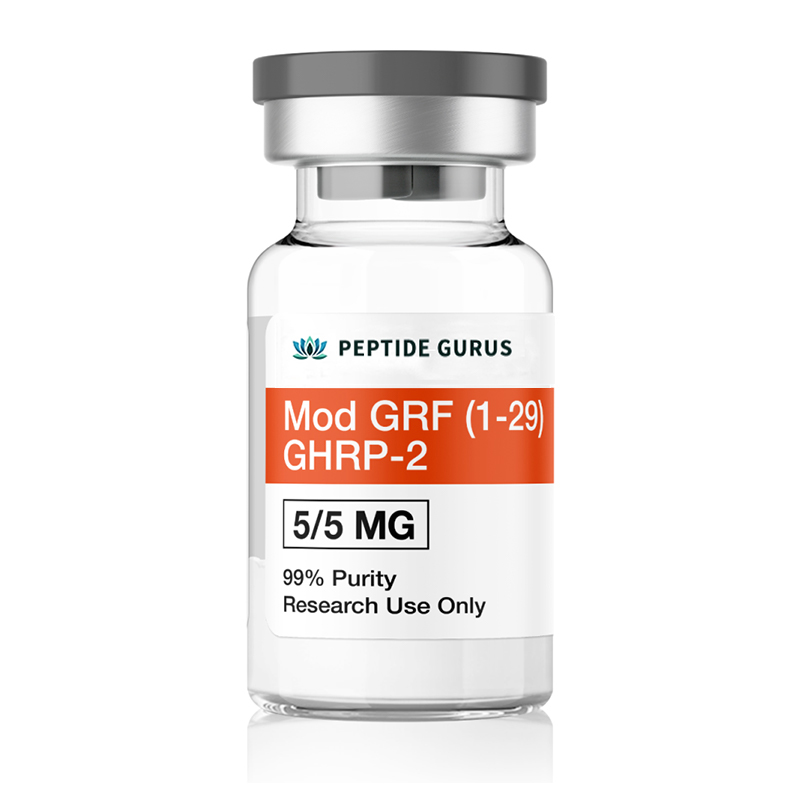
Los agonistas del receptor secretagogo de la hormona del crecimiento (GHSR), como el GHRP-2, son bien conocidos por su capacidad para producir grandes picos en los niveles de GH. Estos picos, si bien proporcionan una serie de beneficios interesantes e importantes en modelos animales, también son de corta duración porque la vida media de la mayoría de los agonistas de GHSR es relativamente corta. Para lograr aumentos a largo plazo en los niveles de GH, es posible utilizar un análogo de GHRH como el GRF modificado. Esto proporciona un aumento a largo plazo en los niveles basales y máximos de GH, pero no se acerca al tipo de pico de GH que proporcionan los agonistas de aGHSR. Además, los modelos animales muestran que los análogos de GHRH son susceptibles a la interferencia de la somatostatina, lo que puede compensar los aumentos en los niveles de GH.
Para obtener lo mejor de ambos mundos, se están llevando a cabo investigaciones sobre la combinación de agonistas de GHSR y análogos de GHRH. Una combinación particularmente investigada es GRF modificado con GHRP-2[4]. La sinergia proporciona mayores niveles basales y máximos de GH, así como picos medidos que aumentan los beneficios de ambos péptidos de una manera que simplemente aumentar uno u otro no puede lograrse.
El resultado neto de combinar estos péptidos es una mejor liberación de GH y cambios sustanciales en el metabolismo lejos de la deposición de grasa. La masa corporal magra aumenta sustancialmente, los niveles de insulina disminuyen y el azúcar en la sangre se vuelve más regulado2i-4. Incluso hay evidencia que demuestra que ambos péptidos, pero particularmente la ipamorelina, pueden ayudar a mejorar la densidad mineral ósea y la salud de los huesos.Acerca del autorInvestigación realizada por L. Edmiston, M.D. para PEPTIDE GURUS. L. Edmiston tiene un doctorado en medicina de la Facultad de Medicina de la Universidad Case Western Reserve y una licenciatura en ciencias. en biología molecular.Revista CientíficaAutorDr. Jan lzdebski has been listed as a noteworthy Chemist, researcher by Marguis Who’sWho. He attained a Master of Science from University Warsaw, Poland, 1959 and is aDoctor of Philosophy, University Warsaw, Poland, 1965, along with a Doctor of ScienceUniversity Warsaw, Poland, 1979. He studied how GRF 1-29 is more resistant toenzymatic degradation and how that affects its half-life.
Dr. Jan lzdebski is being referenced as one of the leading scientists involved in theresearch and development of GRF 1-29. In no way is this doctor/scientist endorsing oradvocating the purchase, sale, or use of this product for any reason. There is no affiliationor relationshin, implied or otherwise, between PEPTIDE GURUS and this doctor. Thepurpose of citing the doctor is to acknowledge, reconize, and credit the exhaustiveresearch and development efforts conducted by the scientists studving this peptide. DrJan lzdebski is listed in [7]under the referenced citations.Recursos[1]M.Waelbroeck,P.Robberecht, D.H. Coy, J.-C. Camus. P. D. Neef. and J.Christophe, “Interaction of Growth Hormone-Releasing Factor (GRF) and 14 GRFAnalogs with Vasoactive Intestinal Peptide (VlP) Receptors of Rat Pancreas.Discovery of (N-Ac-Tyr1,D-Phe2)-GRF(1-29)-NH2 as a VIP Antagonist,Endocrinology, vol.116,no.6,pp.2643-2649,Jun.1985.[PubMed]
[2] A.V. Schally, X. Zhang, R. Cai, J. M. Hare, R. Granata, and M. Bartoli, “Actionsand potential therapeutic applications of growth hormone-releasing hormoneagonists,” Endocrinology.[PubMed]
[3]E.Adeghate and A,S, Ponery, “Mechanism of ipamorelin-evoked insulin releasefrom the pancreas of normal and diabetic rats.” Neuro Endocrinol Lett.. yol. 25.no6,pp.403-406,Dec.2004.[PubMed]
[4]D.E.Beck,W.B.Sweeney, M.D.McCarter, and lpamorelin 201 Study Group.Prospective, randomized, controlled, proof-of-concept study of the Ghrelin mimeticipamorelin for the management of postoperative ileus in bowe resection patients,Int. J.Colorectal Dis., vol.29,no.12,pp.1527-1534,Dec.2014.[PubMed]
[5]N.B. Andersen, K. Malmlöf, P. B. Johansen, T. T. Andreassen, G. ②rtoft, and H.Oxlund, “The growth hormone secretagoque ipamorelin counteracts glucocorticoid.induced decrease in bone formation of adult rats,” Growth Horm. lGF Res. Off. J.Growth Horm.Res.Soc.Int.IGF Res.Soc., vol.11,no.5,pp.266-272,0ct. 2001[PubMed]
[6]J.Svensson et al., “The GH secretagogues ipamorelin and GH-releasingpeptide-6 increase bone mineral content in adult female rats,” J. Endocrinol.. vol.165,no.3, pp.569-577,Jun.2000.[PubMed]
[7] lzdebski, J., et al.“Potent Trypsin-Resistant HGH-RH Analogues.” Journal of PEPTIDE GURUS : An Official Publication of the European Peptide Society[Semantics Scholar]
ALL ARTICLES AND PRODUCT INFORMATION PROVIDED ON THIS WEBSITE AREFOR INFORMATIONAL AND EDUCATIONAL PURPOSES ONLY.
The products offered on this website are furnished for in-vitro studies onlv, In-vitro studies(Latin: in glass) are performed outside of the body. These products are not medicines ordrugs and have not been approved by the FDA to prevent, treat or cure any medicalcondition, ailment or disease. Bodily introduction of any kind into humans or animals isstrictly forbidden by law.