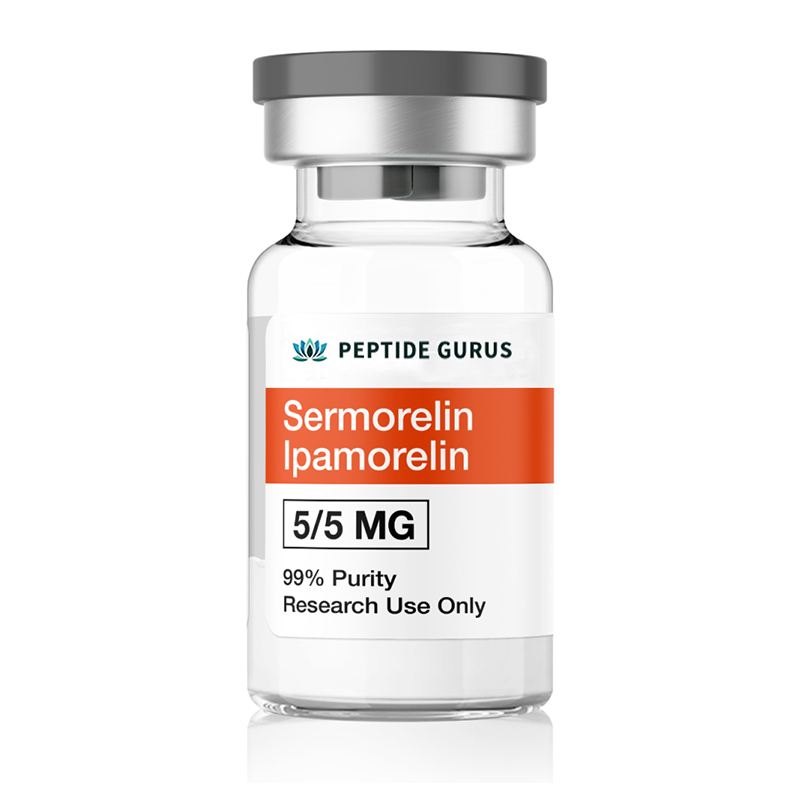
Sermorelin e IpamorelinQuizás la forma más específica de provocar la liberación máxima de la hormona del crecimiento es mediante la combinación de sermorelina e ipamorelina. Sermorelin es un análogo de la hormona liberadora de la hormona del crecimiento (GHRH) desarrollado recientemente y diseñado para preservar los efectos positivos de la GHRH natural y al mismo tiempo evitar algunos de los efectos indeseables. Del mismo modo, la ipamorelina es el análogo más específico y dirigido del secretagogo de la hormona del crecimiento/grelina que se conoce actualmente. Cuando se combinan, estos péptidos actúan sinérgicamente para provocar una liberación extrema de la hormona del crecimiento y así maximizar los beneficios que tiene la GH sobre el crecimiento muscular, la salud del cerebro, la salud del corazón y el metabolismo.
Los efectos específicos de la sermorelina dan como resultado mejores efectos de la hormona del crecimiento en el corazón. La investigación en cerdos muestra que la sermorelina reduce la muerte celular de los cardiomiocitos, mejora la curación después de una lesión cardíaca, estimula el crecimiento de los vasos sanguíneos colaterales y reduce la inflamación [1], [2]. También se ha encontrado recientemente una forma del receptor de grelina en el tejido cardíaco, donde se ha demostrado que afecta el gasto cardíaco. Se ha demostrado que la administración de grelina y análogos de grelina reduce el riesgo de latidos cardíacos anormales y puede mejorar la curación después de una lesión cardíaca [3].
La sermorelina y la ipamorelina tienen beneficios específicos relacionados con la GH que son más potentes que los observados con otros péptidos liberadores de GH. Además de los beneficios para el corazón mencionados anteriormente, las investigaciones han demostrado que la sermorelina beneficia al sistema nervioso central y mejora la calidad del sueño en modelos animales [4], [5]. La lpamorelina se ha relacionado con la salud ósea, el control de la insulina en la diabetes y la motilidad intestinal (particularmente después de una cirugía)[6]-[10].Acerca del autorInvestigación realizada por L. Edmiston, M.D. para PEPTIDE GURUS. L. Edmiston tiene un doctorado en medicina de la Facultad de Medicina de la Universidad Case Western Reserve y una licenciatura en ciencias. en biología molecular.Revista CientíficaAutorRichard F. Walker, Ph.D, R.Ph, lead author of A better approach to management of adult-onset growth hormone insufficiency?”, received a BS in pharmacy from RutgersUniversity, a MS in Biochemistry from New Mexico State University and a PhD in aphysiology from Rutgers University. He holds postdoctoral fellowships inneuroendocrinology and neuropharmacology at Duke University College of Medicine(Center for the Study of Aging and Human Development) and the University of California.Berkeley,respectively.
Richard F. Walker, Ph.D, R.Ph is being referenced as one of the leading scientistsinvolved in the research and development of Sermorelin. In no way is this doctor/scientistendorsing or advocating the purchase, sale, or use of this product for any reason. Thereis no affiliation or relationship, implied or otherwise, between PEPTIDE GURUS and thisdoctor. The purpose of citing the doctor is to acknowledge, recognize, and credit theexhaustive research and development efforts conducted by the scientists studying thispeptide. Richard F. Walker, Ph.D, R.Ph is listed in [11] under the referenced citations.Recursos1.L.L. Bagno et al., “Growth Hormone-Releasing Hormone Agonists ReduceMyocardial Infarct Scar in Swine With Subacute lschemic Cardiomyopathy,” J. AmHeart Assoc.Cardiovasc.Cerebrovasc. Dis., vol. 4, no.4, Mar. 2015.[PubMed]
2.R. M. Kanashiro-Takeuchi et al., “New therapeutic approach to heart failure due tomyocardial infarction based on targeting growth hormone-releasing hormonereceptor,”Oncotarget, vol.6, no.12,pp.9728-9739, Mar. 2015.[PubMed]
3.T. Tokudome, K. Otani, M. Miyazato, and K. Kangawa, “Ghrelin and the heart,Peptides, vol.111,pp.42-46,2019.[PubMed]
4.S. Tang et al., “Interactions between GHRH and GABAARs in the brains of patientswith epilepsy and in animal models of epilepsy,” Sci. Rep., vol.7, Dec. 2017.[PubMed]
5.B.S. Shepherd et al., “Endocrine and orexigenic actions of growth hormonesecretagogues in rainbow trout (Oncorhynchus mykiss),” Comp. Biochem. PhysiolA.Mol.Integr. Physiol., vol. 146, no.3, pp.390-399, Mar. 2007.[PubMed]
6.N. B. Andersen, K. Malmlöf, P. B. Johansen, T. T. Andreassen, G. ②rtoft, and H.Oxlund, “The growth hormone secretagogue ipamorelin counteracts glucocorticoid.induced decrease in bone formation of adult rats,” Growth Horm. IGF Res. Off. J.Growth Horm.Res.Soc.Int.IGF Res.Soc., vol.11,no.5,pp.266-272,0ct. 2001[PubMed]
7.J.Svensson et al., “The GH secretagogues ipamorelin and GH-releasing peptide-6increase bone mineral content in adult female rats,” J. Endocrinol.. vol. 165. no. 3.pp.569-577,Jun.2000.[PubMed]
8.N. K. Aagaard et al., “Growth hormone and growth hormone secretagogue effectson nitrogen balance and urea synthesis in steroid treated rats,” Growth Horm. lGFRes.Off. J.Growth Horm.Res.Soc.Int.lGF Res.Soc., vol. 19, no.5, pp.426-431,Oct.2009.[PubMed]
9.E.Adeghate and A.S. Ponery, “Mechanism of ipamorelin-evoked insulin releasefrom the pancreas of normal and diabetic rats,” Neuro Endocrinol. Lett.. vol. 25, no.6, pp.403-406, Dec.2004.[PubMed]
10.D.E.Beck,W.B.Sweeney, M.D. McCarter, and lpamorelin 201 Study Group*Prospective, randomized, controlled, proof-of-concept study of the Ghrelin mimeticipamorelin for the management of postoperative ileus in bowel resection patients,Int.J. Colorectal Dis., vol.29,no.12,pp.1527-1534, Dec.2014.[PubMed]
11.R.F. Walker, “Sermorelin: A better approach to management of adult-onset growthhormone insufficiency?,”Clin.Interv.Aging, vol. 1, no.4, pp.307-308, Dec.2006[PubMed]
ALL ARTICLES AND PRODUCT INFORMATION PROVIDED ON THIS WEBSITE AREFOR INFORMATIONAL AND EDUCATIONAL PURPOSES ONLY.
The products offered on this website are furnished for in-vitro studies only. in-vitro studies(Latin: in glass) are performed outside of the body. These products are not medicines ordrugs and have not been approved by the FDA to prevent, treat or cure any medicalcondition, ailment or disease. Bodily introduction of any kind into humans or animals isstrictly forbidden by law.