Envoyez-nous un e-mail dès maintenant pour passer votre commande avec un support individuel. Stock limité ! Nous acceptons Zelle, CashApp, Venmo, virements bancaires et cryptomonnaies.
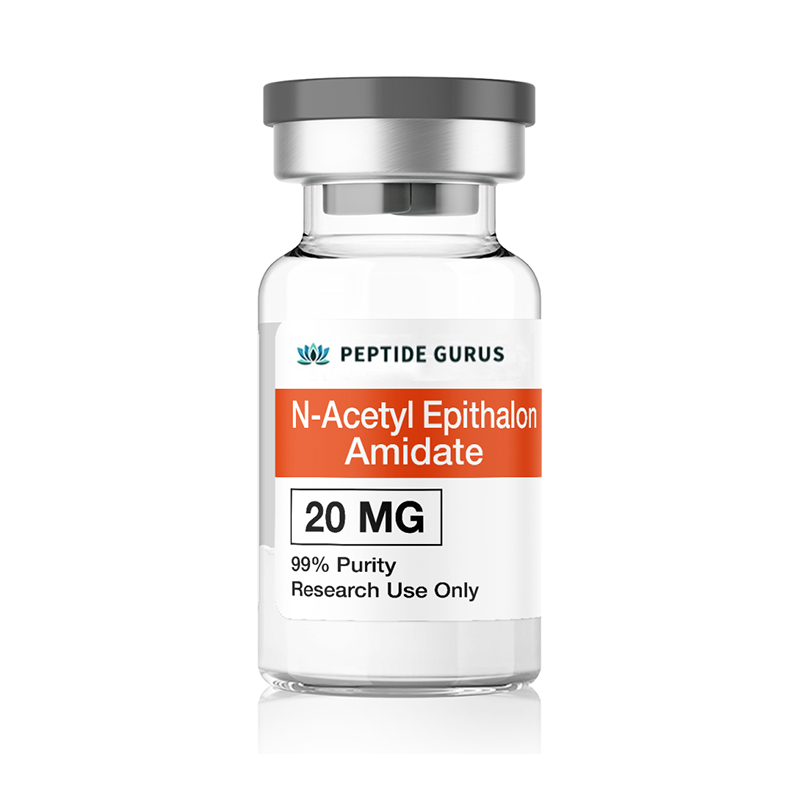
N-Acetyl Epithalon Amidate is a modified version of the synthetic peptide Epithalon (a.k.a. Epitalon). Epithalon itself is a component of naturally occurring cow pineal gland extract that is now produced synthetically. It is well known in research settings for its anti-aging properties and significant effects on cancer, infectious disease, DNA (primarily telomere) regulation, and skin health.
Even though Epithalon was discovered roughly forty years ago at the St. Petersburg Institute of Bioregulation and Gerontology, the peptide is still under active research and providing new insights. Most recently, scientists proposed potential epigenetic mechanisms to explain the influence that Epithalon has on neuronal differentiation of stem cells.
N-acétyl Epitalon Amidate Structure
Séquence d'acides aminés:Ala-glu-asp-glyFormule chimique:C14H22N4O9Masse moléculaire:390,349 g / molPubChem CID: 219042
Masse moléculaire:446,45 g / molNuméro CAS:307297-39-8Synonyme:Epitalon, épithalon, épithalamine, épithalamineSource:Se publierIci, dans la séquence, «l'ac-» représente le groupe acétyle attaché à l'extrémité N-terminale du peptide, et «-NH2» représente le groupe aminé à l'extrémité C-terminale. La séquence d'acides aminés «Agagaaga» correspond au peptide Epitalon central. L'acétyl-épisital-amiate est une version modifiée d'Epitalon, un peptide synthétique avec des propriétés potentielles d'anti-âge et d'activation de la télomérase. L'ajout des groupes acétyl et aminés peut améliorer sa stabilité, sa biodisponibilité et son efficacité.
N-acétyl Epithalon Amidate: Modifications
The modifications to Epithalon do not alter the peptide’s overall function, but they do alter the half-life, stability, and efficacy of Epithalon. Only two modifications are made to the native peptide: N-acetylation and amidation. Each has specific benefits that make Epithalon more potent and allow for lower dosing of the peptide.
Acetylation is a common, natural process that occurs to many proteins in the body. It is also a process used by the pharmaceutical industry to help a compound to reach the central nervous system. Acetylated molecules are much more capable of crossing the blood-brain barrier (BBB). Acetylation has been shown to increase the rate at which a compound crosses the BBB, thereby increasing the intensity of the compound’s effects and helping reduce the dosage of a compound required to achieve a specific outcome. Aspirin, for instance is the acetylated form of salicylic acid. Research shows that acetylation of salicylic acid increases the anti-inflammatory effects of the molecule.
Amidation is another natural protein modification that has been coopted by the pharmaceutical industry to improve the half-life of compounds. Amidated proteins are less sensitive to proteolytic degradation in the blood stream. They also tend to bind more strongly to their receptors, making amidation an excellent means of increasing potency and efficacy of a compound.
By altering Epithalon via acetylation and amidation, it is possible to increase the penetration of the peptide into the central nervous and protect it from degradation during the process. The result is increased potency of a given dose of Epithalon as well as increased efficacy of the compound due to improved receptor binding
N-acétyl épithalon amidant et le cerveau
Research in cell culture shows that Epithalon influences gene expression in neurogenetic differentiation as well as protein synthesis. Molecular modeling suggests that occurs through epigenetic modulation of a handful of genes coding for the proteins Nestin, GAP43, β Tubulin III, and Doublecortin. Epithalon increases expression of these peptides by as much as 1.8 times via binding with specific histone proteins and allowing the genes to be accessed more easily[1]. The result of easier access to the DNA in those regions is increased expression of the genes and thus increased protein production.
The proteins being affected by Epithalon are important in the growth and development of neurons as follows.
Nestine - Cette protéine filamentaire intermédiaire est exprimée dans les cellules nerveuses et joue un rôle important dans la croissance radiale des axones. Il aide également les cellules souches à se différencier en cellules nerveuses, stimulant ainsi la croissance des tissus dans le système nerveux central (SNC).
GAP43 - GAP43 est souvent appelé la protéine «plasticité» car joue un rôle important dans les cônes de croissance neuronaux pendant le développement et la régénération axonale. Il joue un rôle critique dans l'apprentissage. La suppression d'un seul allèle du gène GAP43 conduit à la déficience intellectuelle.
β tubuline III - Cet élément de microtubule se trouve dans les neurones et les cellules de testicules où elle est impliquée dans la formation de microtubules et les réponses au stress oxydatif. La recherche suggère qu'il est important dans l'adaptation cellulaire au stress moléculaire et que les carences dans cette protéine peuvent jouer un rôle clé dans l'agressivité tumorale.
Doublecortine - Doublecortin est une protéine associée aux microtubules trouvée dans les neurones immatures. Il est essentiel au développement de structures cérébrales complexes. Les carences dans le doublecortine ont été liées au syndrome du double cortex dans lequel un manque de migration de neurones immatures conduit à un cerveau lisse chez les hommes et les neurones mal placés chez les femmes. Le résultat d'une carence est une profonde invalidité intellectuelle.
En améliorant l'accès aux régions d'ADN contenant les gènes qui contrôlent les protéines ci-dessus, l'épithalon a été lié à l'amélioration de l'apprentissage, à une récupération améliorée de la blessure du SNC et potentiellement à des réductions des effets à long terme du vieillissement sur le cerveau. Cette dernière caractéristique n'est qu'une des nombreuses façons dont l'épithalon a été constaté qu'il affecte positivement le processus de vieillissement. Il a été démontré que l'épithalon affecte la différenciation des cellules souches neuronales en favorisant la croissance et le développement de neurones des progéniteurs des cellules souches [2]. Avec une demi-vie plus longue et une pénétration améliorée dans le SNC, la puissance et les effets de l'amide d'épithalon n-acétyle seront améliorés par rapport à l'épitthalon standard.
N-acétyle Epithalon Amidate and Skin Health
The ability of Epithalon to regulate gene expression patterns is hardly limited to the CNS. Research in skin stem cell cultures shows that Epithalon, even at very low concentrations increases proliferation of stems cells in rats regardless of age. In particular, fibroblast proliferation rates increase by as much as 45%[3].
It isn’t just the growth of fibroblasts that is affected, however. Research shows that Epithalon (and other short polyfunctional peptides) decrease rates of apoptosis and increase functional activity of fibroblasts[4]. This leads to “normalization” of the intracellular matrix. In other words, Epithalon restores homeostasis (biological balance) to the skin and helps to shift the balance in aging skin toward more youthful production of things like collage, elastin, and other proteins[4]. The net result is improved skin health. In fact, Epithalon has opened up a new field in research, referred to as gerontocosmetology, focused on skin health in age.
It is important to note that while cosmetology has a definite component focused on appearance, the field is much deeper than that. The visual effects of cosmetology overlay the deeper components of skin health. Aging skin appears wrinkled, for instance, because of a loss of extracellular matrix proteins like collagen and elastin. Replacement of these proteins, among others, reduces the appearance of wrinkles but also improves the strength and integrity of skin. Skin is the first line of defense against infection and is often referred to as the large organ of the immune system. Healthy skin means less infection, faster wound healing, better insulation against cold, improved response to heat, and much more. Thus, the field of gerontocosmetology is focused not just on the surface, but on the holistic health of the skin and thus the human body[3].
N-acétyle épithalon amidant et santé immunitaire
Un autre domaine dans lequel Epithalon joue un rôle actif dans la régulation des gènes est le système immunitaire. La recherche sur la culture cellulaire montre que l'épithalon modifie l'expression de molécules de signalisation immunitaire comme le CD5, l'IL-2, l'arylalkylamine-N-acétyltransférase, l'interféron gamma et le tram1. Chacune de ces protéines affecte le système immunitaire comme suit.
CD5 - CD5 influence la différenciation des cellules du système immunitaire, aidant les cellules souches à passer à des cellules fonctionnelles qui luttent contre l'infection et luttent contre l'inflammation.
IL-2 - IL-2 est un puissant régulateur de la production de globules blancs.
L'arylalkylamine-n-acétyltransférase - Cette enzyme est essentielle à la production de mélatonine, qui n'est pas seulement importante dans le sommeil mais joue également un rôle essentiel dans la régulation du système immunitaire.
Interféron gamma - La recherche chez le rat montre que l'interféron gamma est important pour lutter contre l'infection via l'activation des macrophages, des cellules tueuses naturelles et des cellules T. Il comme joue un rôle essentiel dans la réponse du corps à l'infection virale en particulier [5].
La détérioration de la réponse immunitaire est l'un des principaux marqueurs et moteurs du vieillissement. La fonction immunitaire dérégulée entraîne une inflammation chronique et joue un rôle dans le développement des maladies cardiovasculaires et de la démence. La capacité de l'épithalon à réguler le système immunitaire est l'une des façons dont elle contrecarre les effets du vieillissement. Encore une fois, la capacité de l'amide d'épithalon n-acétyle à pénétrer dans le SNC contribue à garantir que ses effets améliorants immunitaires sont ressentis dans le cerveau, où la régulation de l'inflammation peut aider à tempérer les processus qui mènent à la démence.
N-acétyl épithalon amidait et cancer
La recherche dans des modèles de rats de diverses tumeurs a montré que l'administration quotidienne d'épithalon réduit la croissance tumorale [6]. Le peptide est actuellement à l'étude comme un adjuvant potentiel au traitement des cancers du sein HER-2 / Neu (hormonal positif) ainsi que la leucémie et le cancer des testicules. Fait intéressant, l'une des actions primaires de l'épithalon dans le cancer semble être par la régulation du gène Per1. Per1, qui se trouve dans l'hypothalamus, régule le rythme circadien et s'est avéré être sous-exprimé chez les patients cancéreux [7].
N-acétyl épithalon amidant et sommeil
As noted above, Epithalon regulates the production of the protein PER1, which plays an important role in circadian rhythm. This should come as no surprise given that Epithalon was first isolated from the pineal gland of cows and the primary role of the pineal gland is to regulate the sleep-wake cycle and the response of many animals to light. Research in rats shows that Epithalon also regulates the production and release of melatonin, which is a potent regulator of sleep.
Via action at the genes for arylalkylamine-N-acetyltransferase and pCREM, Epithalon increases melatonin production and can restore normal sleep-wake cycles[8]. Melatonin and sleep patterns often become dysregulated because of age, a phenomenon that is more than likely a result of changes in DNA expression patterns. By restoring DNA expression to a more youthful state, Epithalon helps to offset age-related changes in sleep. This, in turn, as a tremendous impact on everything from cognitive function to wound healing, the immune response, growth hormone secretion, weight gain, bone structure, and cardiovascular health.
N-acétyl épithalon amidant et vieillissement
Each of the above sections has dealt with a specific feature of Epithalon function, but each has also made note of the fact that Epithalon helps to restore DNA expression patterns in aging animals to those seen in younger animals. Indeed, restoration of youthful DNA expression patterns is the overarching theme associated with Epithalon. Production of this peptide by the pineal gland appears to decline with age, resulting in many of the age-related changes that impact health and longevity. Supplementation with Epithalon in insects and rodents has shown that Epithalon can decrease mortality by more than half and prolong life by as much as 27%[9].
The above changes in DNA expression patterns, possibly through epigenetic changes that result of histone protein binding, is at least part of the reason that Epithalon has such profound effects on aging. It is not the whole story though. Research shows that Epithalon also impacts antioxidant activity and telomere health.
In rat models. Injection of Epithalon has been shown to decrease LPO production and reduce oxidative modification of proteins[10]. LPO production (lipid peroxidation products) result from lipid peroxidation, which is a normal biological process known to production free radicals. LPO is necessary for several normal biological functions, such as the destruction of invading pathogens and the recycling of damaged proteins. The production of potentially dangerous free radicals is offset by the equal production of antioxidants. With aging, however, antioxidant production wanes thus cellular and protein damage from free radical production increases. Epithalon offsets the decline in antioxidant production and thus helps to maintain the homeostatic balance that prevents damage from free radicals.
Research in human somatic cells shows that Epithalon activates an enzyme called telomerase[11]. Telomerase is important for maintain the end caps of DNA called telomeres. Telomeres are regions of the DNA that don not contain genes, but instead protect DNA during the process of replication. Replication slowly erodes DNA so having telomeres helps to prevent functional DNA from being damaged. Unfortunately, telomeres themselves degrade over time and when they get too short, cells stop functioning and eventually die. Telomerase helps to repair telomeres and thus helps to extend the lifespan of cells. By increasing activity of telomerase, Epithalon is directly impacting the health of DNA and thus how long cells live[12], [13].
Aging, in general, can be divided into several categories, but they are all interlinked. In general, DNA damage leads to protein malfunction. This, combined with direct protein damage, leads to cellular dysfunction. As cellular dysfunction accumulates, cells are either killed or become non-functional in a process known as senescence. Over time, both processes lead to tissue and organ dysfunction that eventually produces signs of aging like changes in sleep patterns, weight gain, wrinkling, greying of the hair, and increased incidence of chronic disease. The accumulation of this “macro-damage” is what eventually leads to death as the body becomes unable to sustain normal biological function. Epithalon helps to offset much of this dysfunction by regulating DNA and protein damage at a fundamental level.
N-acétyle Epithalon Amidate: Résumé
Bien que l'épithalon ne soit pas la réponse unique à l'arrêt du processus de vieillissement, il donne un aperçu de la façon de contrer certains des processus fondamentaux qui conduisent à des dommages à l'ADN et aux protéines peuvent aider à contrecarrer le processus de vieillissement global. Selon le Dr Vladimir Khavison, le parrain du développement d'Élithalon, alors que la recherche sur Epithalon continue, la science acquiert une compréhension plus profonde et plus nuancée de ce qui fait vieillir les mammifères, en général, et les humains et finalement mourir. L'épithalon est une clé importante pour comprendre comment les processus biochimiques peuvent être modifiés pour ralentir, voire à arrêter certaines des causes fondamentales du vieillissement. Le développement de l'amide d'épithalon n-acétyle est une partie importante de la recherche sur l'épithalon, car sa capacité à pénétrer le SNC facilitera les chercheurs pour explorer les effets de l'épithalon sur le vieillissement dans le cerveau. Cela donnera probablement un aperçu de la façon dont les processus biochimiques tels que le sommeil et la croissance des neurones affectent l'apprentissage, la mémoire, la résilience cognitive et bien plus encore.
Article auteur
La littérature ci-dessus a été étudiée, édité et organisée par le Dr E. Logan, M.D. Le Dr E. Logan est titulaire d'un doctorat à partir deCase Western Reserve University School of Medicineet un B.S. en biologie moléculaire.
Auteur de journal scientifique
Vladimir Khavinsonest professeur, président de la région européenne de l'Association internationale de gérontologie et de gériatrie; Membre duAcademies russes et ukrainiennes des sciences médicales; Gérontologue principal du comité de santé du gouvernement de Pétersbourg, Russie; Directeur du Saint-Pétersbourg Institute of Bioregulation and Gerontology; Vice-président de la Société gérontologique de laAcadémie russe des sciences; Chef du président de la gérontologie et de la gériatrie de l'Université médicale d'État de l'époque, St-Petersburg; Colonel of Medical Service (URSS, Russie), Retired.Vladimir Khavinson est connu pour la découverte, les études expérimentales et cliniques de nouvelles classes dePeptideBiorégulateurs ainsi que pour le développement de la thérapie peptidique biorégulante. Il est engagé dans l'étude du rôle des peptides dans la régulation des mécanismes de vieillissement. Son principal domaine d'actions est les études de conception, précliniques et cliniques de nouveaux peptidesgéroprotecteurs. A 40-year-long investigation resulted in a multitude of methods of application of peptide bioregulators to slow down the process of ageing and increase human life span. Six peptide-based pharmaceuticals and 64 peptide food supplements have been introduced into clinical practice by V. Khavinson. He is an author of 196 patents (Russian and international) as well as of 775 scientific publications.His major achievements are presented in two books: “Peptides and Ageing” (NEL, 2002)and “Gerontological aspects of genome peptide regulation” (Karger AG, 2005).Vladimir Khavinson introduced scientific specialty “Gerontology and Geriatrics” in the Russian Federation on the governmental level. Academic Council headed by V. Khavinson has oversighted over 200 Ph.D. and Doctorate theses from many different countries.
Prof. Vladimir Khavinson is being referenced as one of the leading scientists involved in the research and development of N-Acetyl Epithalon Amidate. In no way is this doctor/scientist endorsing or advocating the purchase, sale, or use of this product for any reason. There is no affiliation or relationship, implied or otherwise, between
Gourous peptidiquesEt ce médecin. Le but de citer le médecin est de reconnaître, de reconnaître et de créditer les efforts exhaustifs de recherche et de développement menés par les scientifiques qui étudient ce peptide.
Citations référencées
V. Khavinsonet al.,AEDG Peptide (Epitalon) Stimulates Gene Expression and Protein Synthesis during Neurogenesis: Possible Epigenetic Mechanism ,”Mol. Basel Switz., vol. 25, no. 3, p. E609, Jan. 2020, doi: 10.3390/molecules25030609.
S. Caputiet al., “Effect of short peptides on neuronal differentiation of stem cells,”Int. J. Immunopathol. Pharmacol., vol. 33, p. 2058738419828613, Feb. 2019, doi: 10.1177/2058738419828613.
N. I. Chalisova, N. S. Lin’kova, A. N. Zhekalov, A. O. Orlova, G. A. Ryzhak, and V. K. Khavinson, “[Short peptides stimulate skin cell regeneration during ageing],”Adv. Gerontol. Uspekhi Gerontol,, vol. 27, no. 4, pp. 699–703, 2014.
V. K. Khavinson, N. S. Linkova, A. S. Diatlova, E. O. Gutop, and O. A. Orlova, “[Short peptides: regulation of skin function during aging.],”Adv. Gerontol. Uspekhi Gerontol., vol. 33, no. 1, Art. no. 1, 2020.
N. Lin’kova, B. Kuznik, and V. Khavinson, “The peptide Ala-Glu-Asp-Gly and interferon gamma: Their role in immune response during aging,”Adv. Gerontol., vol. 3, Apr. 2013, doi: 10.1134/S2079057013020100.
I. A. Vinogradova, A. V. Bukalev, M. A. Zabezhinski, A. V. Semenchenko, V. K. Khavinson, and V. N. Anisimov, “Effect of Ala-Glu-Asp-Gly peptide on life span and development of spontaneous tumors in female rats exposed to different illumination regimes,”Bull. Exp. Biol. Med.,vol. 144, no. 6, pp. 825–830, Dec. 2007, doi: 10.1007/s10517-007-0441-z.
S. Gery, N. Komatsu, L. Baldjyan, A. Yu, D. Koo, and H. P. Koeffler, “The circadian gene per1 plays an important role in cell growth and DNA damage control in human cancer cells,”Mol. Cell, vol. 22, no. 3, pp. 375–382, May 2006, doi: 10.1016/j.molcel.2006.03.038.
O. Korkushkoet al., “[Normalizing effect of the pineal gland peptides on the daily melatonin rhythm in old monkeys and elderly people],”Adv. Gerontol. Uspekhi Gerontol. Ross. Akad. Nauk Gerontol. Obshchestvo, vol. 20, pp. 74–85, Feb. 2007.
V. N. Anisimov, S. V. Mylnikov, and V. K. Khavinson, “Pineal peptide preparation epithalamin increases the lifespan of fruit flies, mice and rats,”Mech. Ageing Dev., vol. 103, no. 2, pp. 123–132, Jun. 1998, doi: 10.1016/S0047-6374(98)00034-7.
L. S. Kozina, “Effects of bioactive tetrapeptides on free-radical processes,”Bull. Exp. Biol. Med., vol. 143, no. 6, Art. no. 6, Jun. 2007, doi: 10.1007/s10517-007-0230-8.
V. Kh. Khavinson, I. E. Bondarev, and A. A. Butyugov, “Epithalon Peptide Induces Telomerase Activity and Telomere Elongation in Human Somatic Cells,”Bull. Exp. Biol. Med., vol. 135, no. 6, Art. no. 6, Jun. 2003, doi: 10.1023/A:1025493705728.
T. A. Dzhokhadze, T. Z. Buadze, M. N. GaÄozishvili, M. A. Rogava, and T. A. Lazhava, “[Functional regulation of genome with peptide bioregulators by hypertrophic cardiomyopathy (by patients and relatives)],”Georgian Med. News, no. 225, Art. no. 225, Dec. 2013.
V. N. Anisimov, “Effect of Epitalon on biomarkers of aging, life span and spontaneous tumor incidence in female Swiss-derived SHR mice,”Biogerontology, vol. 4, no. 4, pp. 193–202, 2003, doi: 10.1023/a:1025114230714.Tous les articles et informations sur les produits fournis sur ce site Web sont à des fins informationnelles et éducatives uniquement.Les produits proposés sur ce site Web sont fournis uniquement pour des études in vitro. Des études in vitro (latin: en verre) sont réalisées en dehors du corps. Ces produits ne sont pas des médicaments ou des médicaments et n'ont pas été approuvés par la FDA pour prévenir, traiter ou guérir une condition médicale, une maladie ou une maladie. L'introduction corporelle de toute nature dans l'homme ou les animaux est strictement interdite par la loi.
Peptidegurus est l'un des principaux fournisseurs de peptides de recherche de fabrication américaine, offrant des produits de qualité supérieure à des prix compétitifs. En mettant l'accent sur l'excellence et le service à la clientèle, ils garantissent un processus de commande sécurisé et pratique avec l'expédition mondiale.