

• Prostamax (Bioregulator) peptide anti - aging mechanism exploration
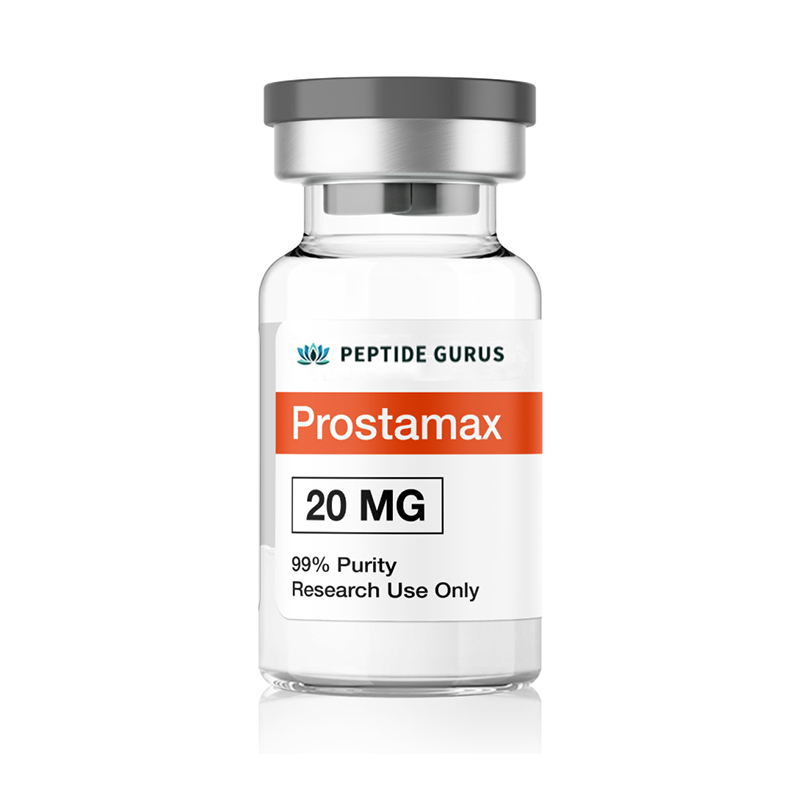
Prostamax 20 mg (biorégulateur)
X
Prostamax 20 mg (biorégulateur)

Prostamax 20 mg (biorégulateur)

Catégories:, ,

Contact pour commander
Envoyez-nous un e-mail dès maintenant pour passer votre commande avec un support individuel. Stock limité ! Nous acceptons Zelle, CashApp, Venmo, virements bancaires et cryptomonnaies.
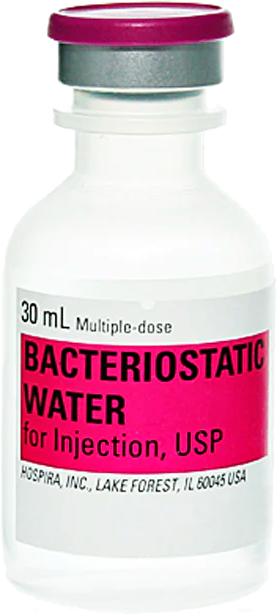
Eau bactériostatique

Eau bactériostatique libre (1) 30 ml
avec des commandes qualifiées sur500 USD. (exclut les produits de capsule, les peptides cosmétiques, les codes promotionnels et l'expédition)

La prostamax est un peptide biorégulateur synthétique de Khavinson avec des effets profonds sur la condensation de l'ADN dans un certain nombre de cellules. Bien qu'il soit principalement intéressant pour ses effets anti-âge et anti-inflammatoires sur la prostate, la prostamax s'est également avérée optimiser la fonction d'un certain nombre de cellules dans le corps (par exemple les lymphocytes) en modifiant les témoins épigénétiques sur l'ADN.
Utilisation du produit:Ce produit est conçu uniquement comme un produit chimique de recherche.Cette désignation permet l'utilisation de produits chimiques de recherche strictement pour les tests in vitro et l'expérimentation de laboratoire uniquement. Toutes les informations sur les produits disponibles sur ce site Web sont à des fins éducatives uniquement. L'introduction corporelle de toute nature dans l'homme ou les animaux est strictement interdite par la loi. Ce produit ne doit être géré que par des professionnels agréés et qualifiés. Ce produit n'est pas une drogue, de la nourriture ou un cosmétique et peut ne pas être mal étendu, mal utilisé ou erroné comme drogue, aliment ou cosmétique.

PROSTAMAX 20MG – Research Grade Peptide

Prostamax is a bioregulatory peptide primarily studied in prostate and urogenital system research. It has been widely used in studies related to cellular regulation, tissue differentiation, and age-related functional changes within prostate tissues.

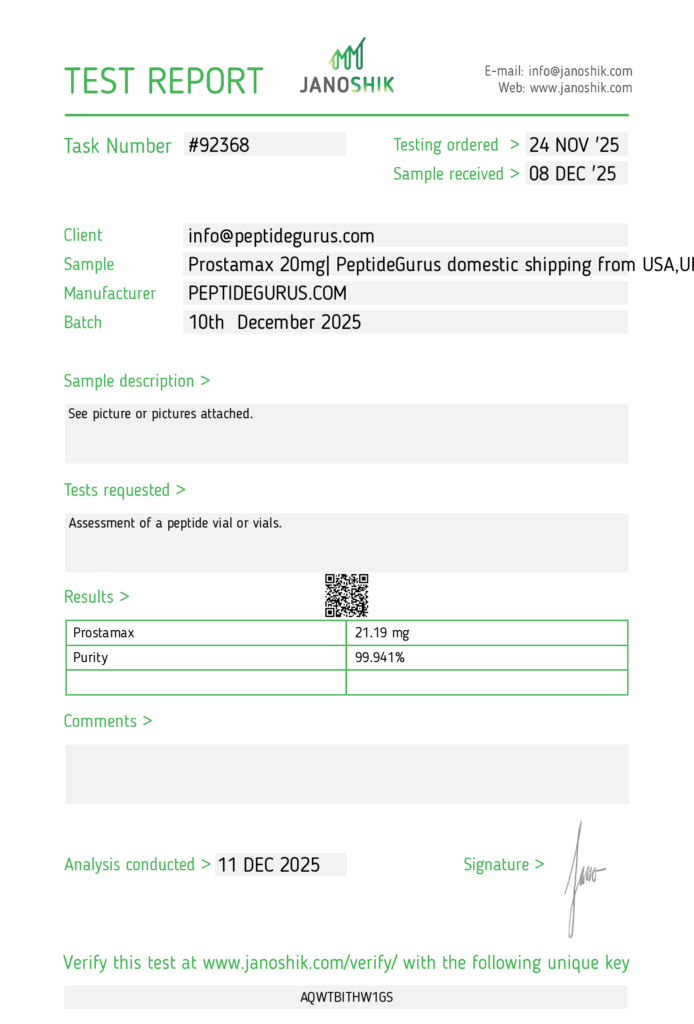
NotreProstamax 20mgis manufactured under strict quality control standards to ensurehigh purity, structural stability, and consistent batch performance. The lyophilized presentation allows for easy handling, extended shelf life, and reliable storage conditions.

This peptide is suitable for research facilities, pharmaceutical development teams, and peptide distributors specializing in urogenital and endocrine-related research.

Prostamax

La prostamax est un peptide synthétique de Khavinson avec des effets de réparation primaires dans la prostate [1]. Il a également été démontré que le peptide améliore la fonction des lymphocytes et modifie les modèles d'expression de l'ADN dans d'autres tissus. La prostamax est considérée comme l'un des peptides de Khavinson anti-âge à spectre plus large car il favorise le décondensage de l'hétérochromatine dans une grande variété de cellules. La recherche chez le rat indique que la prostamax peut être utile dans le traitement de la prostatite chronique. Il existe des spéculations selon lesquelles l'utilisation à long terme peut écarter le cancer, bien que des études de longueur suffisante pour démontrer que cela n'a pas encore été réalisée.

Structure de la prostamax

Séquence d'acides aminés:Lys-Glu-Asp-Pro (KEDP)Formule moléculaire:C20H33N5O9Poids moléculaire:487,5 g / molPubChem CID: 9848296 Synonymes:Schembl660498MoleculeSource:Se publier

Prostamax et la prostate

Chronic prostate inflammation (called chronic prostatitis) affects as many as 16% of men at some point in their lives. It is a painful condition causing burning with urination, urgency, and trouble voiding. It can even cause difficult or painful ejaculation along with pain in the lower back. It is notoriously difficult to treat, often requiring long-term antibiotic treatment over months. There is also good evidence to suggest that it can lead to cardiovascular disease and even cancer, so treating prostatitis is crucial to long-term health[2]. Research in rat models shows that prostatitis can be treated with Prostamax, which reduces the signs and symptoms of the disease. Rats treated with Prostamax for just 15 days showed reduce swelling of the prostate gland along with less vascular congestion (hyperemia) and less infiltration by cells of the immune system. Interestingly, the rats also showed decreased levels of scarring in the prostate, indicating that the reduction in inflammation was slowing or even stopping pathological remodeling. Though the study was not carried out long enough or on enough rats to assess Prostamax’s effect on the risk for cancer, the results suggest that it would likely diminish the risk by reducing chronic inflammation that leads to pathological hypertrophy and hyperplasia[3]. According to Dr. Angelina Pakhomova, what makes the above study on Prostamax extra exciting is that it was effective in treating a form of prostatitis called chronic abacterial prostatitis (CAP). CAP is the most common form of prostatitis, but it is difficult to treat because it isn’t caused by a bacterial infection. Bacterial infections respond readily to antibiotics. CAP, on the other hand, does not respond as well to antibiotic treatment and sometimes doesn’t respond at all. It is also more likely to recur and has been shown to be exceptionally frustrating to those who suffer from it. Having an alternative treatment that is effective in CAP could improve quality of life for many men and ward off future disease. Finding a treatment for CAP is more important than ever as rates of the condition have increased almost 3-fold since the end of the 20èmesiècle.

Prostamax et le système immunitaire

Though Prostamax is considered to be tissue-specific, there is ample evidence that the bioreulator acts on cells outside of the prostate. The most consequential effects are on the ribosomes and densely packed chromatin found in lymphocytes. In these cells, Prostamax, like Epithalon and Vilon, serves to increase expression of ribosomes which are responsible for the translation of mRNA into proteins. It also opens up densely packed chromatin to make genes more accessible for transcription into mRNA. Thus, Prostamax sets the stage for increased gene expression at every level, allowing for a functional change in the health of lymphocytes[4], [5]. The impact of Prostamax on the immune system is not just theoretical either. Research shows that the peptide helps to reduce signs of chronic prostate inflammation including swelling, hyperemia, and lymphocyte infiltration.[3] This results both from the influence Prostamax has on lymphocytes and their control over the immune response as well as the role the peptide plays in normalizing growth and differentiation of prostate cells.

Prostamax et vieillissement

The effects that Prostamax has on lymphocytes and cells of the prostate are part of a larger effect it has one many different types of cells. Research in cell cultures taken from older individuals shows that Prostamax alters DNA structure by decondensing heterochromatin. This, in turn, allows for greater expression of DNA that was inactivated via dense packaging of DNA[6]. What makes this remarkable in terms of aging is that condensation of DNA is a normal, if undesirable, consequence of aging. DNA condensation is a primary driver of both senescence and apoptosis, making it one of the most important mechanisms of aging. By unpacking DNA, Prostamax is literally giving the cells a more youthful genetic profile. The results are increased proliferation of cells, decreased apoptosis (programmed cell death), and improved protein expression and cell function. Interestingly, Prostamax and similar epigenetically active peptides are found naturally in long-lived rodent species like the African mole rat. These same peptides arepastrouvé dans les espèces de courte durée [7]. Cela indique que les effets épigénétiques qui ont été observés avec des peptides comme la prostamax sont, en fait, directement liés au vieillissement et à la longévité.

Résumé de la prostamax

La prostamax est un peptide synthétique de Khavinson avec des effets profonds sur la condensation de l'ADN dans un certain nombre de cellules. Bien qu'il soit principalement intéressant pour ses effets anti-âge et anti-inflammatoires sur la prostate, la prostamax s'est également avérée optimiser la fonction d'un certain nombre de cellules dans le corps (par exemple les lymphocytes) en modifiant les témoins épigénétiques sur l'ADN.

Article auteur

La littérature ci-dessus a été étudiée, édité et organisée par le Dr E. Logan, M.D. Le Dr E. Logan est titulaire d'un doctorat à partir deCase Western Reserve University School of Medicineet un B.S. en biologie moléculaire.

Auteur de journal scientifique

Vladimir Khavinsonest professeur, président de la région européenne de l'Association internationale de gérontologie et de gériatrie; Membre duAcademies russes et ukrainiennes des sciences médicales; Gérontologue principal du comité de santé du gouvernement de Pétersbourg, Russie; Directeur du Saint-Pétersbourg Institute of Bioregulation and Gerontology; Vice-président de la Société gérontologique de laAcadémie russe des sciences; Chef du président de la gérontologie et de la gériatrie de l'Université médicale d'État de l'époque, St-Petersburg; Colonel of Medical Service (URSS, Russie), Retired.Vladimir Khavinson est connu pour la découverte, les études expérimentales et cliniques de nouvelles classes dePeptideBiorégulateurs ainsi que pour le développement de la thérapie peptidique biorégulante. Il est engagé dans l'étude du rôle des peptides dans la régulation des mécanismes de vieillissement. Son principal domaine d'actions est les études de conception, précliniques et cliniques de nouveaux peptidesgéroprotecteurs. A 40-year-long investigation resulted in a multitude of methods of application of peptide bioregulators to slow down the process of ageing and increase human life span. Six peptide-based pharmaceuticals and 64 peptide food supplements have been introduced into clinical practice by V. Khavinson. He is an author of 196 patents (Russian and international) as well as of 775 scientific publications.His major achievements are presented in two books: “Peptides and Ageing” (NEL, 2002)and “Gerontological aspects of genome peptide regulation” (Karger AG, 2005).Vladimir Khavinson introduced scientific specialty “Gerontology and Geriatrics” in the Russian Federation on the governmental level. Academic Council headed by V. Khavinson has oversighted over 200 Ph.D. and Doctorate theses from many different countries. Prof. Vladimir Khavinson is being referenced as one of the leading scientists involved in the research and development of Prostamax. In no way is this doctor/scientist endorsing or advocating the purchase, sale, or use of this product for any reason. There is no affiliation or relationship, implied or otherwise, between
Gourous peptidiquesEt ce médecin. Le but de citer le médecin est de reconnaître, de reconnaître et de créditer les efforts exhaustifs de recherche et de développement menés par les scientifiques qui étudient ce peptide.

Citations référencées

    A. N. Zakutskiĭ, N. I. Chalisova, G. A. Ryzhak, A. I. Aniskina, S. V. Filippov, and P. N. Zeziulin, “[The tissue-specific effect of synthetic peptides-biologic regulators in organotypic tissues culture in young and old rats],”Adv. Gerontol. Uspekhi Gerontol., vol. 19, pp. 93–96, 2006. “Treating chronic prostatitis,”Harvard Health, Dec. 21, 2017. https://www.health.harvard.edu/mens-health/treating-chronic-prostatitis (accessed Feb. 22, 2022). T. G. Borovskayaet al., “Experimental studying of the drug efficiency Prostamax in the therapy of chronic aseptic prostatitis and its complications,”Mod. Res. Inflamm., vol. 2013, Jul. 2013, doi: 10.4236/mri.2013.23007. V. K. Khavinson, T. A. Lezhava, and V. V. Malinin, “Effects of short peptides on lymphocyte chromatin in senile subjects,”Bull. Exp. Biol. Med., vol. 137, no. 1, pp. 78–81, Jan. 2004, doi: 10.1023/b:bebm.0000024393.40560.05. T. Meskhiet al., “[The influence of the peptide bioregulator prostamax on heterochromatin of human lymphocytes in situ],”Biofizika, vol. 49, no. 6, pp. 1091–1093, Dec. 2004. T. A. Dzhokhadze, T. Z. Buadze, M. N. Gaĭozishvili, N. A. Baratashvili, and T. A. Lezhava, “[Deheterochromatinization of the chromatin in old age induced by oligopeptide bioregulator (Lys-Glu-Asp-Pro)],”Georgian Med. News, no. 212, pp. 76–82, Nov. 2012. V. K. Khavinson, D. Y. Kormilets, and A. T. Mar’yanovich, “Peptides (Epigenetic Regulators) in the Structure of Rodents with a Long and Short Lifespan,”Bull. Exp. Biol. Med., vol. 163, no. 5, pp. 671–676, Sep. 2017, doi: 10.1007/s10517-017-3876-x.
Tous les articles et informations sur les produits fournis sur ce site Web sont à des fins informationnelles et éducatives uniquement.Les produits proposés sur ce site Web sont fournis uniquement pour des études in vitro. Des études in vitro (latin: en verre) sont réalisées en dehors du corps. Ces produits ne sont pas des médicaments ou des médicaments et n'ont pas été approuvés par la FDA pour prévenir, traiter ou guérir une condition médicale, une maladie ou une maladie. L'introduction corporelle de toute nature dans l'homme ou les animaux est strictement interdite par la loi.

Demander une enquête

À propos de nous

Peptidegurus est l'un des principaux fournisseurs de peptides de recherche de fabrication américaine, offrant des produits de qualité supérieure à des prix compétitifs. En mettant l'accent sur l'excellence et le service à la clientèle, ils garantissent un processus de commande sécurisé et pratique avec l'expédition mondiale.

Demander un devis

  • Gourous peptidiques
  • info@peptidegurus.com
  • Glendale, c'est, USA
  • CONTACT

    Demander une enquête