

カテゴリ:ペプチドとその用量
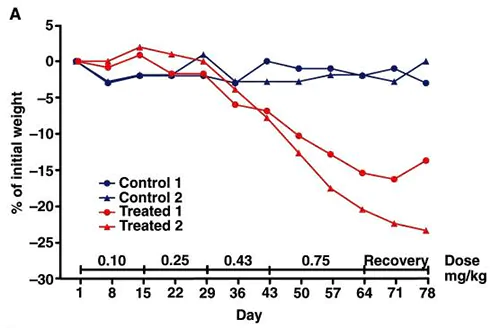
 A. Percent weight loss in control groups (blue) versus those treated with adipotide (two differing doses, shown in red)
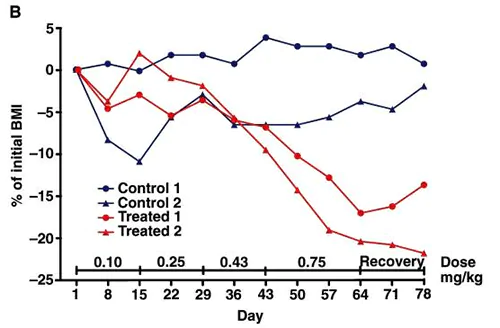
B. Percent reduction in BMI (control versus treatment)
Source: PubMed
A. Percent weight loss in control groups (blue) versus those treated with adipotide (two differing doses, shown in red)
B. Percent reduction in BMI (control versus treatment)
Source: PubMed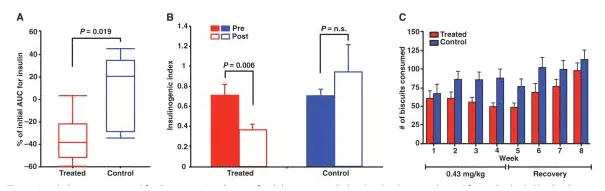 A. Shows the change in insulin requirements (area under the curve) for treated (red) and control (blue) groups. The AUC was calculated from an IVGTT test.
B. Shows the insulinogenic index for before and after in the treatment (red) and control (blue) groups. Treated groups show a dramatic decrease in insulin secretion.
C. Change in biscuit consumption in treated (red) and control (blue) groups.
Source: PubMed
The targeting of adipotide to the blood vessels serving fat cells may be mediated by a protein receptor called prohibitin. Prohibitin is a membrane protein that may only be found in blood vessels serving white fat and in cancer cells. It has been demonstrated that adipotide associates with this protein[2]. If it turns out that prohibitin is found only in fat vasculature and cancer tissue, then adipotide testing will be responsible for identifying a fat-specific target that can be used not just for therapeutic purposes, but for diagnostic purposes as well.
2. Adipotide and Cancer
Prohibitin, the molecule that adipotide likely targets in fat cells, has been associated with certain types of cancer[3]. Cancer cells are known to require substantial blood supplies in order to grow and metastasize. The ability to target prohibitin in cancer cells may provide for advanced therapies that target cancer without harming surrounding tissues.
3. Adipotide and Glucose Tolerance
Glucose tolerance is a term that refers to higher than normal levels of blood sugar. The condition is generally diagnosed with a blood test and confirmed by testing fasting glucose levels or by administering a glucose tolerance test in which a set amount of sugar is consumed and then blood levels of sugar are measured. Glucose tolerance is a proxy measure for diabetes, with increased glucose tolerance indicating a trend toward diabetes.
Treating elevated glucose levels can be done with diet and exercise, but these methods require dedication and motivation. They also take considerable time to have an effect. In general, most people with impaired glucose tolerance go on to develop overt type 2 diabetes and require drugs like metformin and, in some cases, insulin. Research into adipotide has revealed that the peptide produces rapid and weight-independent improvement in glucose tolerance[4]. The latter part is critical, because it indicates that a reduction in white fat by adipotide is effective in reducing glucose tolerance regardless of the impact on weight. In other words, it is the fat loss that is important, not the weight loss. These findings not only open the pathway for developing new treatments for pre-diabetes and diabetes, they help to clarify and explain the mechanisms that lead to diabetes in the first place.
There is some argument as to whether adipotide directly causes fat loss or simply decreases food intake which indirectly leads to fat loss[4]. It is likely that adipotide directly causes fat loss. This hypothesis is supported by the fact that the peptide causes changes in fat cell density without causing weight loss and affects glucose tolerance without causing weight loss.将来のアディポチド研究The primary area of adipotide research is in fat loss and diabetes. The peptide targets specific cells in the blood vessels that supply fat tissue, causing those blood vessels to die and, as a result, causing the fat cells they supply to die. Adipotide is an anti-angiogenic peptide, which means it targets blood vessels. Anti-angiogenic molecules are of keen interest right now in the treatment of cancer. There is limited, but promising research, on the role of adipotide in cancer.
Adipotide exhibits minimal side effects, low oral and excellent subcutaneous bioavailability in mice. Per kg dosage in mice does not scale to humans. Adipotide for sale at PEPTIDE GURUS is limited to educational and scientific research only, not for human consumption. Only buy Adipotide if you are a licensed researcher.記事著者上記の文献は、M.D。Logan博士によって研究、編集、および組織されました。Logan博士は、ケースウエスタンリザーブ大学医学部およびB.S.の博士号を取得しています。分子生物学で。Scientific Journalの著者Kirstin Barnhart, MD, lead author of “A peptidomimetic targeting white fat causes weight loss and improved insulin resistance in obese monkeys,” is Associate Director, Senior Pathologist at AbbVie – a leading pharmaceutical research and development company. Dr. Barnhart led a study where the treatment with adipotide induced targeted apoptosis within blood vessels of white adipose tissue and resulted in rapid weight loss and improved insulin resistance in obese monkeys. Magnetic resonance imaging and dual-energy x-ray absorptiometry confirmed a marked reduction in white adipose tissue.
Kirstin Barnhart, MD is being referenced as one of the leading scientists involved in the research and development of Adipotide. In no way is this doctor/scientist endorsing or advocating the purchase, sale, or use of this product for any reason. There is no affiliation or relationship, implied or otherwise, between PEPTIDE GURUS and this doctor. The purpose of citing the doctor is to acknowledge, recognize, and credit the exhaustive research and development efforts conducted by the scientists studying this peptide. Dr. Barnhart is listed in [6] under the referenced citations.アディポチド資源K. F. Barnhart et al., “A peptidomimetic targeting white fat causes weight loss and improved insulin resistance in obese monkeys,” Sci. Transl. Med., vol. 3, no. 108, p. 108ra112, Nov. 2011.
M. G. Kolonin, P. K. Saha, L. Chan, R. Pasqualini, and W. Arap, “Reversal of obesity by targeted ablation of adipose tissue,” Nat. Med., vol. 10, no. 6, pp. 625–632, Jun. 2004.
F. I. Staquicini et al., “Vascular ligand-receptor mapping by direct combinatorial selection in cancer patients,” Proc. Natl. Acad. Sci. U. S. A., vol. 108, no. 46, pp. 18637–18642, Nov. 2011.
D.-H. Kim et al., “Rapid and weight-independent improvement of glucose tolerance induced by a peptide designed to elicit apoptosis in adipose tissue endothelium,” Diabetes, vol. 61, no. 9, pp. 2299–2310, Sep. 2012.
L. Criscione, “Comment on ‘a peptidomimetic targeting white fat causes weight loss and improved insulin resistance in obese monkeys,’” Sci. Transl. Med., vol. 4, no. 131, pp. 131le2; author reply 131lr2, Apr. 2012.
Barnhart KF, Christianson DR, Hanley PW, et al. A peptidomimetic targeting white fat causes weight loss and improved insulin resistance in obese monkeys. Sci Transl Med. 2011;3(108):108ra112. doi:10.1126/scitranslmed.3002621
ALL ARTICLES AND PRODUCT INFORMATION PROVIDED ON THIS WEBSITE ARE FOR INFORMATONAL AND EDUCATIONAL PURPOSES ONLY.
The products offered on this website are furnished for in-vitro studies only. In-vitro studies (Latin: in glass) are performed outside of the body. These products are not medicines or drugs and have not been approved by the FDA to prevent, treat or cure any medical condition, ailment or disease. Bodily introduction of any kind into humans or animals is strictly forbidden by law.
A. Shows the change in insulin requirements (area under the curve) for treated (red) and control (blue) groups. The AUC was calculated from an IVGTT test.
B. Shows the insulinogenic index for before and after in the treatment (red) and control (blue) groups. Treated groups show a dramatic decrease in insulin secretion.
C. Change in biscuit consumption in treated (red) and control (blue) groups.
Source: PubMed
The targeting of adipotide to the blood vessels serving fat cells may be mediated by a protein receptor called prohibitin. Prohibitin is a membrane protein that may only be found in blood vessels serving white fat and in cancer cells. It has been demonstrated that adipotide associates with this protein[2]. If it turns out that prohibitin is found only in fat vasculature and cancer tissue, then adipotide testing will be responsible for identifying a fat-specific target that can be used not just for therapeutic purposes, but for diagnostic purposes as well.
2. Adipotide and Cancer
Prohibitin, the molecule that adipotide likely targets in fat cells, has been associated with certain types of cancer[3]. Cancer cells are known to require substantial blood supplies in order to grow and metastasize. The ability to target prohibitin in cancer cells may provide for advanced therapies that target cancer without harming surrounding tissues.
3. Adipotide and Glucose Tolerance
Glucose tolerance is a term that refers to higher than normal levels of blood sugar. The condition is generally diagnosed with a blood test and confirmed by testing fasting glucose levels or by administering a glucose tolerance test in which a set amount of sugar is consumed and then blood levels of sugar are measured. Glucose tolerance is a proxy measure for diabetes, with increased glucose tolerance indicating a trend toward diabetes.
Treating elevated glucose levels can be done with diet and exercise, but these methods require dedication and motivation. They also take considerable time to have an effect. In general, most people with impaired glucose tolerance go on to develop overt type 2 diabetes and require drugs like metformin and, in some cases, insulin. Research into adipotide has revealed that the peptide produces rapid and weight-independent improvement in glucose tolerance[4]. The latter part is critical, because it indicates that a reduction in white fat by adipotide is effective in reducing glucose tolerance regardless of the impact on weight. In other words, it is the fat loss that is important, not the weight loss. These findings not only open the pathway for developing new treatments for pre-diabetes and diabetes, they help to clarify and explain the mechanisms that lead to diabetes in the first place.
There is some argument as to whether adipotide directly causes fat loss or simply decreases food intake which indirectly leads to fat loss[4]. It is likely that adipotide directly causes fat loss. This hypothesis is supported by the fact that the peptide causes changes in fat cell density without causing weight loss and affects glucose tolerance without causing weight loss.将来のアディポチド研究The primary area of adipotide research is in fat loss and diabetes. The peptide targets specific cells in the blood vessels that supply fat tissue, causing those blood vessels to die and, as a result, causing the fat cells they supply to die. Adipotide is an anti-angiogenic peptide, which means it targets blood vessels. Anti-angiogenic molecules are of keen interest right now in the treatment of cancer. There is limited, but promising research, on the role of adipotide in cancer.
Adipotide exhibits minimal side effects, low oral and excellent subcutaneous bioavailability in mice. Per kg dosage in mice does not scale to humans. Adipotide for sale at PEPTIDE GURUS is limited to educational and scientific research only, not for human consumption. Only buy Adipotide if you are a licensed researcher.記事著者上記の文献は、M.D。Logan博士によって研究、編集、および組織されました。Logan博士は、ケースウエスタンリザーブ大学医学部およびB.S.の博士号を取得しています。分子生物学で。Scientific Journalの著者Kirstin Barnhart, MD, lead author of “A peptidomimetic targeting white fat causes weight loss and improved insulin resistance in obese monkeys,” is Associate Director, Senior Pathologist at AbbVie – a leading pharmaceutical research and development company. Dr. Barnhart led a study where the treatment with adipotide induced targeted apoptosis within blood vessels of white adipose tissue and resulted in rapid weight loss and improved insulin resistance in obese monkeys. Magnetic resonance imaging and dual-energy x-ray absorptiometry confirmed a marked reduction in white adipose tissue.
Kirstin Barnhart, MD is being referenced as one of the leading scientists involved in the research and development of Adipotide. In no way is this doctor/scientist endorsing or advocating the purchase, sale, or use of this product for any reason. There is no affiliation or relationship, implied or otherwise, between PEPTIDE GURUS and this doctor. The purpose of citing the doctor is to acknowledge, recognize, and credit the exhaustive research and development efforts conducted by the scientists studying this peptide. Dr. Barnhart is listed in [6] under the referenced citations.アディポチド資源K. F. Barnhart et al., “A peptidomimetic targeting white fat causes weight loss and improved insulin resistance in obese monkeys,” Sci. Transl. Med., vol. 3, no. 108, p. 108ra112, Nov. 2011.
M. G. Kolonin, P. K. Saha, L. Chan, R. Pasqualini, and W. Arap, “Reversal of obesity by targeted ablation of adipose tissue,” Nat. Med., vol. 10, no. 6, pp. 625–632, Jun. 2004.
F. I. Staquicini et al., “Vascular ligand-receptor mapping by direct combinatorial selection in cancer patients,” Proc. Natl. Acad. Sci. U. S. A., vol. 108, no. 46, pp. 18637–18642, Nov. 2011.
D.-H. Kim et al., “Rapid and weight-independent improvement of glucose tolerance induced by a peptide designed to elicit apoptosis in adipose tissue endothelium,” Diabetes, vol. 61, no. 9, pp. 2299–2310, Sep. 2012.
L. Criscione, “Comment on ‘a peptidomimetic targeting white fat causes weight loss and improved insulin resistance in obese monkeys,’” Sci. Transl. Med., vol. 4, no. 131, pp. 131le2; author reply 131lr2, Apr. 2012.
Barnhart KF, Christianson DR, Hanley PW, et al. A peptidomimetic targeting white fat causes weight loss and improved insulin resistance in obese monkeys. Sci Transl Med. 2011;3(108):108ra112. doi:10.1126/scitranslmed.3002621
ALL ARTICLES AND PRODUCT INFORMATION PROVIDED ON THIS WEBSITE ARE FOR INFORMATONAL AND EDUCATIONAL PURPOSES ONLY.
The products offered on this website are furnished for in-vitro studies only. In-vitro studies (Latin: in glass) are performed outside of the body. These products are not medicines or drugs and have not been approved by the FDA to prevent, treat or cure any medical condition, ailment or disease. Bodily introduction of any kind into humans or animals is strictly forbidden by law.Peptidegurusは、アメリカ製の研究ペプチドの大手サプライヤーであり、競争力のある価格で最高品質の製品を提供しています。卓越性と顧客サービスに重点を置いて、彼らはグローバルな配送で安全で便利な注文プロセスを保証します。
©Copyright Peptide Gurus2024。AllRights Reserved。プライバシーポリシーこのサイトのすべての製品は研究開発用のみです。製品は人間の消費物ではありません。このウェブサイトに記載されている声明は、米国食品医薬品局(FDA)やカナダ保健省によって評価されていません。本社の声明および製品は、いかなる病気の診断、治療、治癒、予防を目的としたものではありません。PeptideGurusは化学薬品の供給業者です。PeptideGurusは、連邦食品医薬品化粧品法503A条に基づく調剤薬局や化学調剤施設ではありません。Peptide Sciencesは連邦食品医薬品化粧品法503B条に基づくアウトソーシング施設ではありません。
接触


