




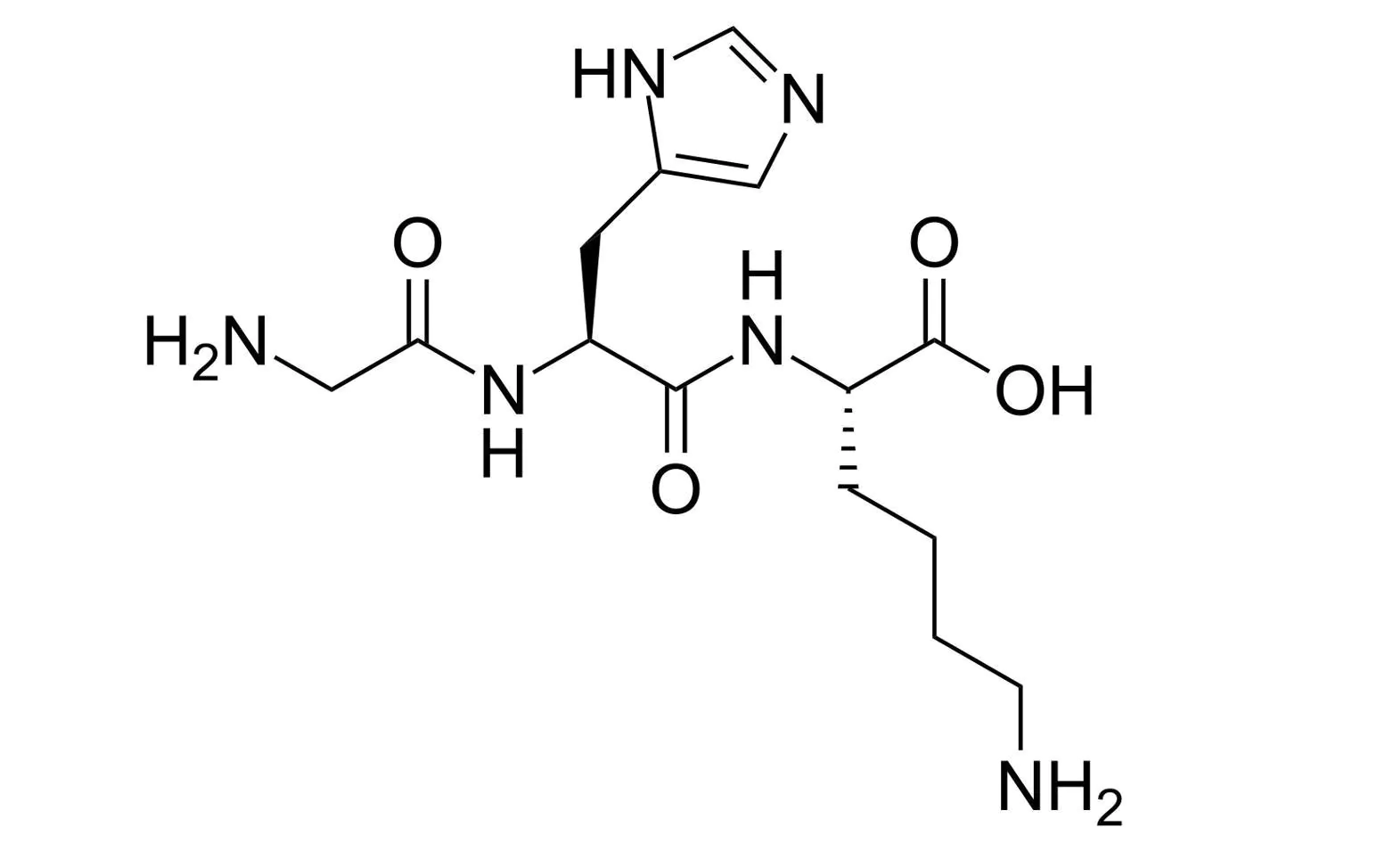
GHK with and without copper affects a large number of genes related to an organism’s response to stress and injury (tissue remodeling, anti-oxidant, anti-inflammatory, anti-pain, anti-anxiety, blood vessel growth, nerve outgrowth, anti-cancer action). GHK sequence is included in the collagen molecule, and SPARC protein and GHK is naturally released after an injury due to protein breakdown.
Copper is a transitional metal that is vital for all eukaryotic organisms from microbes to humans. Since it can be converted from oxidized Cu(II) to reduced Cu(I) form, it functions as an essential cofactor in a multitude of biochemical reactions involving electron transfer.A dozen enzymes use changes in copper oxidation states to catalyze important biochemical reactions, including cellular respiration, antioxidant defense, detoxification, blood clotting, and the connective tissue formation. Copper is required for iron metabolism, oxygenation, neurotransmission, embryonic development and many other essential biological processes.
Recherche de GHK
1. GHK supprime la synthèse du fibrinogène
Fibrinogen consists of three polypeptide chains; alpha, beta, and gamma. GHK strongly suppresses the gene for the beta chain of fibrinogen. A lack of adequate FGB will effectively stop fibrinogen synthesis since equal amounts of all three polypeptide chains are needed to produce fibrinogen. GHK also suppresses the production of the inflammatory cytokine interleukin-6 (IL-6) which is a main positive regulator of fibrinogen synthesis, through its interaction with fibrinogen genes. In cell culture systems, GHK suppresses IL-6 secretion in skin fibroblasts and IL-6 gene expression in SZ95 sebocytes. In summary, the effects of GHK on the FGB gene plus its effects on IL-6 production imply a suppression of overall fibrinogen production.2. GHK active le système d'ubiquitine / protéasome (UPS)
Les UPS suppriment les protéines endommagées. Des activités plus élevées des UPS semblent retarder les effets du vieillissement. GHK a stimulé l'expression des gènes dans 41 gènes UPS tout en supprimant seulement un gène UPS.3. GHK active les gènes de réparation de l'ADN
Les dommages à l'ADN sont rapidement réparés dans les cellules jeunes et saines, cependant, à mesure que nous vieillissons, les dommages à l'ADN commencent à s'accumuler. L'activité de réinitialisation des gènes de réparation de l'ADN peut diminuer les effets délétères du vieillissement. Le GHK était principalement stimulant pour les gènes de réparation de l'ADN (47 en haut, 5 vers le bas).4. GHK agit comme un antioxydant
Les radicaux libres et les produits finaux toxiques de la peroxydation lipidique sont liés à l'athérosclérose, au cancer, aux cataractes, au diabète, à la néphropathie, à la maladie d'Alzheimer et à d'autres conditions pathologiques sévères du vieillissement. Le GHK stimule 14 gènes antioxydants et supprime deux gènes pro-oxydants.5. GHK supprime les gènes de l'insuline et de l'insuline
The insulin family has been proposed as a negative controller of longevity; higher levels of insulin and insulin-like proteins reduce lifespan. GHK stimulates 3 genes in this system and suppresses 6 genes. The insulin/IGF-1- like receptor pathway is a contributor to the biological aging process in many organisms. The gene expression data suggests that GHK suppresses this system as 6 of 9 of the affected insulin/IGF-1 genes are suppressed. Insulin/IGF-1-like signaling is conserved from worms to humans. In vitro experiments show that mutations that reduce insulin/IGF-1 signaling have been shown to decelerate the degenerative aging process and extend lifespan in many organisms, including mice and possibly humans. Reduced IGF-1 signaling is also thought to contribute to the “antiaging” effects of calorie restriction.6. GHK répare le tissu par la superfamille TGF
The most explored of GHK’s actions is the repair of damaged tissues (skin, hair follicles, stomach and intestinal linings, and boney tissue) either by the use of copper-peptide-containing creams or by induction of systemic healing. Campbell et al. found that GHK’s resetting of gene expression of fibroblasts from COPD patients fits into this category of tissue repair via the TGF beta superfamily. Campbell et al. also found that GHK directly increases TGF beta and other family members which activate the repair process.7. Gènes de contrôle du cancer
Les gènes de caspase, de régulation de la croissance et de réparation de l'ADN sont importants dans la suppression du cancer. En 2010, Hong et al. a identifié 54 gènes associés à un cancer du côlon humain agressif, métastatique. La carte de connectivité du large institut a été utilisée pour trouver des composés qui inversent les expressions différentielles de ces gènes. Les résultats ont indiqué que deux molécules de cicatrisation des plaies et de remodelage cutané, GHK à 1 micromolaire et sécurinine à 18 micromolaires, pourraient inverser significativement l'expression différentielle de ces gènes et suggéré qu'ils pouvaient avoir un effet thérapeutique sur les patients sujets aux métastases.Conclusion
The tripeptide GHK possesses many positive effects but declines with age. It improves wound healing and tissue regeneration (skin, hair follicles, stomach and intestinal linings, and boney tissue), increases collagen and glycosaminoglycans, stimulates synthesis of decorin, increases angiogenesis, and nerve outgrowth, possesses antioxidant and anti-inflammatory effects, and increases cellular stemness and the secretion of trophic factors by mesenchymal stem cells. Recently, GHK has even been found to reset genes of diseased cells from patients with cancer or COPD to a healthier state. GHK exhibits minimal side effects, low oral and excellent subcutaneous bioavailability in mice. Per kg dosage in mice does not scale to humans. GHK for sale at
Gourous peptidiquesse limite à la recherche éducative et scientifique uniquement, et non à la consommation humaine. Achetez le GHK si vous êtes un chercheur agréé.
Article auteur
La littérature ci-dessus a été étudiée, édité et organisée par le Dr Logan, M.D. Le Dr Logan est titulaire d'un doctorat à partir deCase Western Reserve University School of Medicineet un B.S. en biologie moléculaire.
Auteur de journal scientifique
Loren Pickart, Ph.D.a publié 109 publications et développe des brevets et analysant les effets de GHK sur l'expression des gènes humains de 4 192 gènes. En plus des utilisations potentielles publiées de GHK surpeauInflammation, cancer métastatique et MPOC, il semble avoir des effets bénéfiques sur d'autres systèmes tissulaires tels que le système nerveux, le système gastro-intestinal et le système mitochondrial. Son autobiographie brève mais détaillée plonge dans les motivations et les antécédents derrière son dédiant à la peau, à l'anti-âge et à une formation à vie.Loren Pickart, Ph.Dest référencé comme l'un des principaux scientifiques impliqués dans la recherche et le développement de GHK-Cu. Ce médecin / scientifique n'est en aucun cas approuvant ou préconise l'achat, la vente ou l'utilisation de ce produit pour quelque raison que ce soit. Il n'y a aucune affiliation ou relation, implicite ou autrement, entre
Gourous peptidiquesEt ce médecin. Le but de citer le médecin est de reconnaître, de reconnaître et de créditer les efforts exhaustifs de recherche et de développement menés par les scientifiques qui étudient ce peptide.Loren Pickart, Ph.D est répertorié dans toutes les citations référencées ci-dessous.
Citations référencées
- Pickart, Loren & Vasquez-Soltero, Jessica & Margolina, Anna. (2015). GHK Peptide as a Natural Modulator of Multiple Cellular Pathways in Skin Regeneration. BioMed Research International. Article ID 648108. 10.1155/2015/648108.
Pickart, L., & Margolina, A. (2018). Regenerative and Protective Actions of the GHK-Cu Peptide in the Light of the New Gene Data.International journal of molecular sciences,19(7), 1987. https://doi.org/10.3390/ijms19071987
Pickart L. The human tri-peptide GHK and tissue remodeling. J Biomater Sci Polym Ed. 2008;19(8):969-88. doi: 10.1163/156856208784909435. PMID: 18644225.
Loren Pickart, Jessica Michelle Vasquez-Soltero, Anna Margolina, “GHK and DNA: Resetting the Human Genome to Health”,BioMed Research International, vol. 2014, Article ID 151479, 10 pages, 2014. https://doi.org/10.1155/2014/151479


