




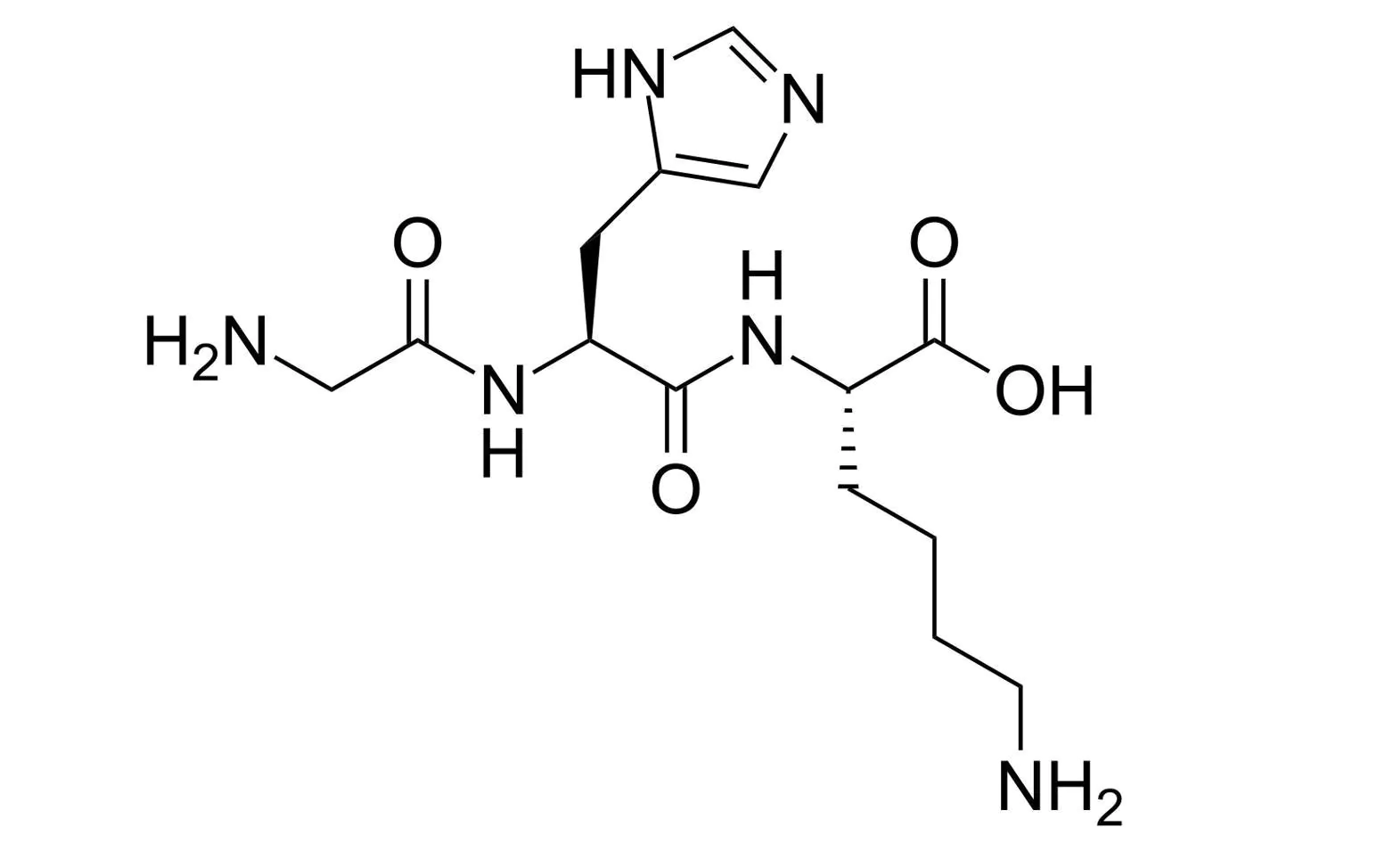
GHK with and without copper affects a large number of genes related to an organism’s response to stress and injury (tissue remodeling, anti-oxidant, anti-inflammatory, anti-pain, anti-anxiety, blood vessel growth, nerve outgrowth, anti-cancer action). GHK sequence is included in the collagen molecule, and SPARC protein and GHK is naturally released after an injury due to protein breakdown.
Copper is a transitional metal that is vital for all eukaryotic organisms from microbes to humans. Since it can be converted from oxidized Cu(II) to reduced Cu(I) form, it functions as an essential cofactor in a multitude of biochemical reactions involving electron transfer.A dozen enzymes use changes in copper oxidation states to catalyze important biochemical reactions, including cellular respiration, antioxidant defense, detoxification, blood clotting, and the connective tissue formation. Copper is required for iron metabolism, oxygenation, neurotransmission, embryonic development and many other essential biological processes.
GHK 연구
1. GHK는 피브리노겐 합성을 억제합니다
Fibrinogen consists of three polypeptide chains; alpha, beta, and gamma. GHK strongly suppresses the gene for the beta chain of fibrinogen. A lack of adequate FGB will effectively stop fibrinogen synthesis since equal amounts of all three polypeptide chains are needed to produce fibrinogen. GHK also suppresses the production of the inflammatory cytokine interleukin-6 (IL-6) which is a main positive regulator of fibrinogen synthesis, through its interaction with fibrinogen genes. In cell culture systems, GHK suppresses IL-6 secretion in skin fibroblasts and IL-6 gene expression in SZ95 sebocytes. In summary, the effects of GHK on the FGB gene plus its effects on IL-6 production imply a suppression of overall fibrinogen production.2. GHK는 유비퀴틴/프로 테아 좀 시스템 (UPS)을 활성화합니다.
UPS는 손상된 단백질을 제거합니다. UPS의 높은 활동은 노화 효과를 지연시키는 것으로 보입니다. GHK는 41 개의 UPS 유전자에서 유전자 발현을 자극하면서 1 개의 UPS 유전자 만 억제했다.3. GHK는 DNA 복구 유전자를 활성화시킨다
그러나 젊고 건강한 세포에서 DNA 손상이 즉시 복구되지만, 나이가 들어감에 따라 DNA 손상이 축적되기 시작합니다. DNA 복구 유전자의 활성을 재설정하면 노화의 해로운 영향을 감소시킬 수 있습니다. GHK는 주로 DNA 복구 유전자에 대한 자극적이었다 (47 UP, 5 다운).4. GHK는 산화 방지제 역할을합니다
지질 과산화의 자유 라디칼 및 독성 최종 제품은 죽상 동맥 경화증, 암, 백내장, 당뇨병, 신장 병증, 알츠하이머 병 및 기타 심각한 병리학 적 조건과 관련이 있습니다. GHK는 14 개의 항산화 유전자를 자극하고 2 개의 프로 산화 유전자를 억제합니다.5. GHK는 인슐린과 인슐린 유사 유전자를 억제합니다
The insulin family has been proposed as a negative controller of longevity; higher levels of insulin and insulin-like proteins reduce lifespan. GHK stimulates 3 genes in this system and suppresses 6 genes. The insulin/IGF-1- like receptor pathway is a contributor to the biological aging process in many organisms. The gene expression data suggests that GHK suppresses this system as 6 of 9 of the affected insulin/IGF-1 genes are suppressed. Insulin/IGF-1-like signaling is conserved from worms to humans. In vitro experiments show that mutations that reduce insulin/IGF-1 signaling have been shown to decelerate the degenerative aging process and extend lifespan in many organisms, including mice and possibly humans. Reduced IGF-1 signaling is also thought to contribute to the “antiaging” effects of calorie restriction.6. GHK는 TGF 슈퍼 패밀리에 의한 조직을 수리합니다
The most explored of GHK’s actions is the repair of damaged tissues (skin, hair follicles, stomach and intestinal linings, and boney tissue) either by the use of copper-peptide-containing creams or by induction of systemic healing. Campbell et al. found that GHK’s resetting of gene expression of fibroblasts from COPD patients fits into this category of tissue repair via the TGF beta superfamily. Campbell et al. also found that GHK directly increases TGF beta and other family members which activate the repair process.7. 암 제어 유전자
카스파 제, 성장 조절 및 DNA 복구 유전자는 암 억제에서 중요합니다. 2010 년, Hong et al. 공격적, 전이성, 인간 결장암과 관련된 54 개의 유전자를 확인 하였다. Broad Institute의 연결 맵은 이들 유전자의 차등 표현을 역전시키는 화합물을 찾는 데 사용되었습니다. 결과는 18 마이크로 몰에서 1 마이크로 몰의 GHK, GHK, 이들 유전자의 차등 발현을 상당히 역전시킬 수 있고 전이성 종료 환자에 치료 효과를 가질 수 있음을 시사한다는 것을 나타냈다.결론
The tripeptide GHK possesses many positive effects but declines with age. It improves wound healing and tissue regeneration (skin, hair follicles, stomach and intestinal linings, and boney tissue), increases collagen and glycosaminoglycans, stimulates synthesis of decorin, increases angiogenesis, and nerve outgrowth, possesses antioxidant and anti-inflammatory effects, and increases cellular stemness and the secretion of trophic factors by mesenchymal stem cells. Recently, GHK has even been found to reset genes of diseased cells from patients with cancer or COPD to a healthier state. GHK exhibits minimal side effects, low oral and excellent subcutaneous bioavailability in mice. Per kg dosage in mice does not scale to humans. GHK for sale at
펩티드 전문가인간 소비가 아닌 교육 및 과학 연구로만 제한됩니다. 면허가있는 연구원 인 경우 GHK 만 구매하십시오.
기사 저자
과학 저널 저자
Loren Pickart, Ph.D.109 개의 간행물을 발표했으며 특허를 개발하고 4,192 개의 유전자의 인간 유전자 발현에 대한 GHK의 영향을 분석하고 있습니다. GHK의 게시 된 잠재적 용도 외에도피부염증, 전이성 암 및 COPD는 신경계, 위장 시스템 및 미토콘드리아 시스템과 같은 다른 조직 시스템에 유익한 영향을 미치는 것으로 보입니다. 그의 짧지 만 상세한 자서전은 피부, 노화 방지 및 평생 훈련에 대한 그의 헌신의 동기와 배경으로 뛰어납니다.Loren Pickart, Ph.DGHK-CU의 연구 및 개발에 관여하는 주요 과학자 중 한 명으로 언급되고 있습니다. 이 의사/과학자가 어떤 이유로 든이 제품의 구매, 판매 또는 사용을지지하거나 옹호하는 것은 아닙니다. 묵시적 또는 다른 방식으로 제휴 나 관계가 없습니다.
펩티드 전문가그리고이 의사. 의사를 인용하는 목적은이 펩티드를 연구하는 과학자들이 수행 한 철저한 연구 개발 노력을 인정, 인정 및 인정하는 것입니다.
참조 인용
- Pickart, Loren & Vasquez-Soltero, Jessica & Margolina, Anna. (2015). GHK Peptide as a Natural Modulator of Multiple Cellular Pathways in Skin Regeneration. BioMed Research International. Article ID 648108. 10.1155/2015/648108.
Pickart, L., & Margolina, A. (2018). Regenerative and Protective Actions of the GHK-Cu Peptide in the Light of the New Gene Data.International journal of molecular sciences,19(7), 1987. https://doi.org/10.3390/ijms19071987
Pickart L. The human tri-peptide GHK and tissue remodeling. J Biomater Sci Polym Ed. 2008;19(8):969-88. doi: 10.1163/156856208784909435. PMID: 18644225.
Loren Pickart, Jessica Michelle Vasquez-Soltero, Anna Margolina, “GHK and DNA: Resetting the Human Genome to Health”,BioMed Research International, vol. 2014, Article ID 151479, 10 pages, 2014. https://doi.org/10.1155/2014/151479


