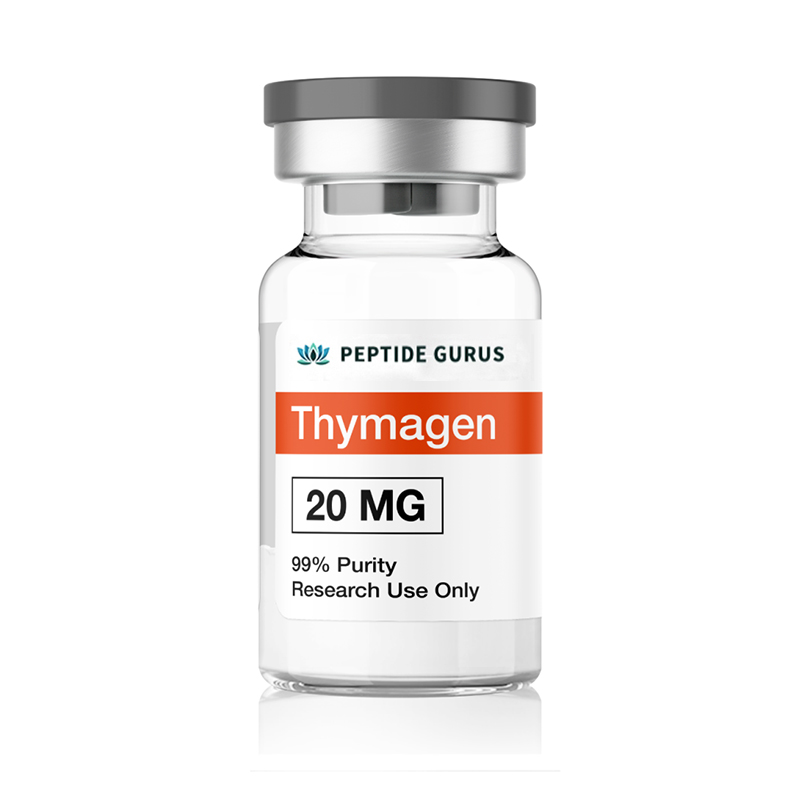
Thymagen is a peptide researched for its role in immune system and thymus-related cellular studies. It has been widely used in immunology research, aging-related studies, and investigations involving immune regulation at the cellular level.
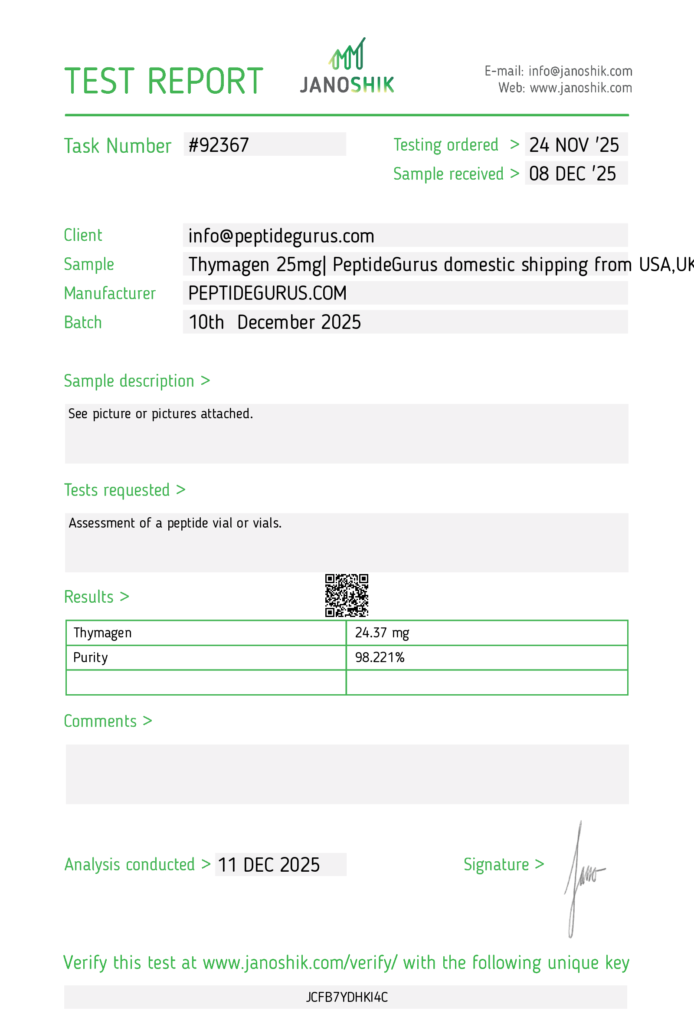
私たちのThymagen 25mgis manufactured to research-grade standards, ensuringhigh purity, strong stability, and consistent quality. The lyophilized form protects the peptide structure and allows for extended storage without degradation.
This product is well-suited for laboratories, biotech companies, and distributors focusing on immune system and longevity-related peptide research.
Cyclic nucleotides are single-phosphate nucleotides with a cyclic bond arrangement between the sugar and phosphate groups. They are integral components of communication within cells, usually acting as second messengers within the cell after a protein on the cell surface has bound to something. In other words, cyclic nucleotides act as messengers within cells for substances that cannot enter the cells themselves.
Research on Thymagen shows that it down regulates cyclic nucleotide catabolism. In other words, Thymagen slows the breakdown of cyclic nucleotides and thereby raises their levels within the cell[1]. This results in enhanced ability of cells, particularly those of the immune system, to respond to messages from other parts of the body. For example, increased levels of cyclic nucleotides could make cells of the immune system more responsive to invading pathogens by improving signaling between these cells.
Summary of nucleoside signaling (nucleotides indicated as NTPs being converted to NMPs). Thymagen has been shown to increase the pool of NTPs and potentiate down-stream effects:ソース:パブThe effects of Thymagen on the immune system begin, but don’t end at cyclic nucleotides though. Research in rat spleen and thymus has shown that Thymagen promotes the maturation of T-lymphoctye precursors into immunocompetent T-cells capable of fending off disease. This process of maturation is driven by the changes that Thymagen induces in cyclic GMP (cGMP) levels[2]. By optimizing cyclic nucleotide ratios, Thymagen helps to ensure that T-lymphocyte precursors are getting the signals that tell them they need to mature into full-flow cells of the immune system.
Thymagen, along with other immunomodulatory molecules like Immunitor and Milife, has also been shown to induce interferon secretion[3]. Interferons are signaling proteins made by host cells in response to viral infection. They serve to modulate and coordinate immune defenses against viruses, but have also been shown to ward off cancer and are generally known as immune regulators. Interferons are used currently in the treatment of autoimmune diseases, such as multiple sclerosis, and in combination with chemotherapy and radiation in the treatment of certain cancers. They are also used in the treatment of both hepatitis B and C.
Research shows that patients with type 1 diabetes are suffering from secondary immunodeficiency in many cases. Thymagen, by promoting T-Cell differentiation, removes signs of this immunodeficiency and helps to correct the deficit. In fact, a clinical effect was seen in nearly 95% of patients in the study[5].
Diabetes actually leads to immunocompromise if left untreated. One of the primary results of this is infection with candida (yeast) species. These types of infection are notoriously difficult to treat and can lead to serious morbidity in people with diabetes. Research with Thymagen indicates that it can slow candidiasis in the setting of secondary immunodeficiency and give existing treatments and edge in eradicating the fungus[6].
Thymagen has been studied as a possible treatment for several different heart conditions. The earliest research looked at the ability of Thymagen to reduce arrhythmia using 6 different models of the disease condition. Research showed a beneficial effect, including a solid dose-response curve that indicated that the observed changes were in fact legitimate[8].
Thymagen has also been studied in isolated heart models where it has been found to have superior protective properties compared to commonly used drugs like verapamil[9]. In the setting of cardiac ischemia, protecting heart muscle from further damage is one of the primary goals of treatment prior to restoration of blood flow via catheterization, bypass grafting, or clot dissolution. Treatment with cardioprotective drugs can help to prevent long-term consequences like heart failure or the need for transplant. Thus, Thymagen may be a useful adjuvant in treating ischemic cardiac injury.
胸腺と癌
Research in rats shows that radiation-induced carcinogenesis can be inhibited by Thymagen. In fact, all carcinogenesis is inhibited by Thymagen, with rats exposed to radiation living roughly average lifespans while rats with no radiation exposure live above average lifespans[10]. This suggests that Thymagen may be a useful cancer preventative, helping to ward off the disease even in the setting of unknown exposures.
According to Dr. Vladimir Anisimov, a collaborator of Dr. Vladimir Khavinson and an expert in cancer development, rats treated with Thymagen have been shown to have a decreased incidence of GI cancer. In fact, regardless of immune status in the study, the rats treated with Thymagen had a 12% reduction in tumor incidence as well as a 1.7-fold reduction in the number of tumors if they did develop cancer[11]. In other words, Thymagen appears to boost immune function against cancer. This suggests that Thymagen works to boost the body’s natural killer cell defenses, which are the front line against cancer, along with other aspects of the innate immune system. This helps to not only prevent cancer from developing, but reduces the rate and severity of spread in rats that do develop cancer.
チマーゲンの概要
Thymagen is a highly active peptide with primary effects on cells of the immune system. It has been shown to increase production and differentiation of T cells, stimulate the secretion of interferons, boost levels of cyclic nucleotides, and promote the functionality of the innate immune system. As a result of its effects on the innate immune system, Thymagen has also been shown to both help prevent cancer and reduce the severity of the disease.
There is good evidence that Thymagen is useful as a peri-operative preventative measures against infection. It has been shown to increase rate of recovery following surgery and is potentially cardioprotective as well.
ウラジミール・ハビンソン老年学と老年学の国際協会の欧州地域の教授であり、ヨーロッパ地域の会長です。のメンバー医学科学のロシア語とウクライナのアカデミー;ロシア州政府政府の保健委員会の主要老年学者。聖ペテルブルク生物調節および老年学研究所のディレクター。老年学会の副会長ロシア科学アカデミー;セントペテルブルクの老年医学および老年科学老年科学部長。医療サービス大佐(ロシア、ソ連)、退職。VladimirKhavinsonは、新しいクラスの発見、実験、臨床研究で知られていますペプチド生体調節因子と生体育成ペプチド療法の開発。彼は、老化のメカニズムの調節におけるペプチドの役割を研究することに従事しています。彼の主な行動分野は、新しいペプチドの設計、臨床前、臨床研究ですゼロゲロテクター. A 40-year-long investigation resulted in a multitude of methods of application of peptide bioregulators to slow down the process of ageing and increase human life span. Six peptide-based pharmaceuticals and 64 peptide food supplements have been introduced into clinical practice by V. Khavinson. He is an author of 196 patents (Russian and international) as well as of 775 scientific publications.His major achievements are presented in two books: “Peptides and Ageing” (NEL, 2002)and “Gerontological aspects of genome peptide regulation” (Karger AG, 2005).Vladimir Khavinson introduced scientific specialty “Gerontology and Geriatrics” in the Russian Federation on the governmental level. Academic Council headed by V. Khavinson has oversighted over 200 Ph.D. and Doctorate theses from many different countries.
Prof. Vladimir Khavinson is being referenced as one of the leading scientists involved in the research and development of Thymagen. In no way is this doctor/scientist endorsing or advocating the purchase, sale, or use of this product for any reason. There is no affiliation or relationship, implied or otherwise, between
S. V. Demidov, A. N. Kostromin, V. V. Kuĭbeda, I. V. Chernaia, and M. I. Borovok, “[Effect of thymagen, thymalin and vilosen on the cAMP and cGMP levels and phosphodiesterase activity in spleen lymphocytes during sensitization and anaphylactic shock],”Ukr. Biokhimicheskii Zhurnal 1978, vol. 63, no. 4, pp. 104–106, Aug. 1991.
A. L. Kozhemiakin, V. G. Morozov, and V. K. Khavinson, “[Participation of the cyclase system in the molecular mechanisms of differentiation control of immunocompetent cells],”Biokhimiia Mosc. Russ., vol. 49, no. 4, pp. 658–666, Apr. 1984.
D. S. Silin, O. V. Lyubomska, F. I. Ershov, V. M. Frolov, and G. A. Kutsyna, “Synthetic and natural immunomodulators acting as interferon inducers,”Curr. Pharm. Des., vol. 15, no. 11, pp. 1238–1247, 2009, doi: 10.2174/138161209787846847.
N. D. Iushchuk, G. I. Tseneva, T. V. Alenushkina, and L. B. Kuliashova, “[The efficacy of using thymogen in an experimental infection caused by Yersinia enterocolitica],”Zh. Mikrobiol. Epidemiol. Immunobiol., no. 3, pp. 106–108, Jun. 1995.
E. A. Zhuk and V. A. Galenok, “[Thymogen in the treatment of type-1 diabetes mellitus],”Ter. Arkh., vol. 68, no. 10, pp. 12–14, 1996.
O. K. Khmel’nitskiĭ, G. M. Iakovlev, V. L. Belianin, V. K. Khavinson, V. G. Morozov, and V. I. Deĭgin, “[The effect of a synthetic thymus peptide (thymogen) on the immune system in candidiasis under immunodepression],”Arkh. Patol., vol. 52, no. 1, pp. 20–25, 1990.
V. S. Smirnov, S. V. Petlenko, and S. S. El’tsin, “[Application thymogen for preoperative preparation of elderly patients with tumor processes in abdominal cavity],”Adv. Gerontol. Uspekhi Gerontol., vol. 24, no. 2, pp. 278–284, 2011.
K. M. Reznikov, O. V. Vinokurova, V. V. Alabovskiĭ, and A. A. Vinokurov, “[The anti-arrhythmia properties of thymogen],”Eksp. Klin. Farmakol., vol. 57, no. 6, pp. 31–33, Dec. 1994.
O. V. Filippova, K. M. Reznikov, V. V. Alabovskił, V. V. Khamburov, and A. A. Vinokurov, “[The effect of thymogen on the heart in ischemia and reperfusion],”Eksp. Klin. Farmakol., vol. 60, no. 3, pp. 27–29, Jun. 1997.
V. N. Anisimov, G. I. Miretskiĭ, V. G. Morozov, I. A. Pavel’eva, and V. K. Khavinson, “[The effect of the synthetic immunomodulator thymogen on radiation-induced carcinogenesis in rats],”Vopr. Onkol., vol. 38, no. 4, pp. 451–458, 1992.
V. G. Bespalov, D. N. Troian, A. S. Petrov, V. G. Morozov, and V. K. Khavinson, “[Inhibiting effect of thymogen on the development of tumors of the esophagus and forestomach induced by N-nitrososarcosine ethyl ester in rats],”Eksp. Onkol., vol. 11, no. 4, pp. 23–26, 1989.このウェブサイトで提供されるすべての記事と製品情報は、情報および教育目的のみを目的としています。このウェブサイトで提供される製品は、ビトロ内の研究のためにのみ提供されています。 in-vitro研究(ラテン語:ガラス)は体の外側で行われます。これらの製品は薬や薬ではなく、病状、病気、病気を予防、治療、治療するためにFDAによって承認されていません。あらゆる種類の人間や動物への身体導入は、法律によって厳密に禁じられています。