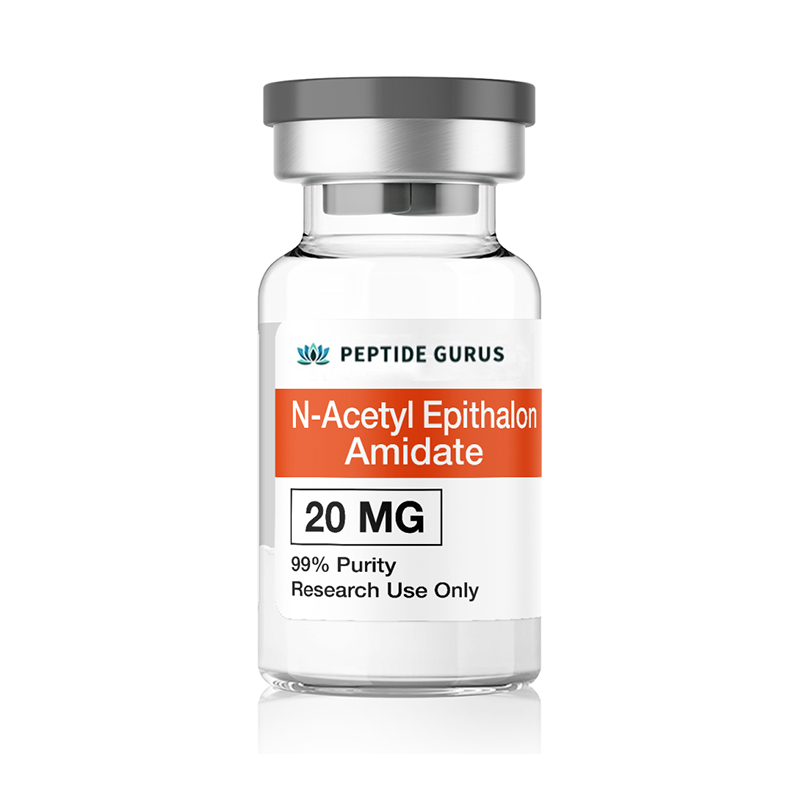
N-Acetyl Epithalon Amidate is a modified version of the synthetic peptide Epithalon (a.k.a. Epitalon). Epithalon itself is a component of naturally occurring cow pineal gland extract that is now produced synthetically. It is well known in research settings for its anti-aging properties and significant effects on cancer, infectious disease, DNA (primarily telomere) regulation, and skin health.
Even though Epithalon was discovered roughly forty years ago at the St. Petersburg Institute of Bioregulation and Gerontology, the peptide is still under active research and providing new insights. Most recently, scientists proposed potential epigenetic mechanisms to explain the influence that Epithalon has on neuronal differentiation of stem cells.
N- 아세틸 epitalon 구조 아미드 구조
아미노산 서열 :Ala-Glu-Asp-Gly화학식 :기음14시간22N4영형9분자 질량 :390.349 g/molPubchem CID : 219042
분자 질량 :446.45 g/molCAS 번호 :307297-39-8동의어:에피탈론, 에피탈론, 에피 탈라 민, 에피탈 라민원천:Pubch여기서,“AC-”는 펩티드의 N- 말단에 부착 된 아세틸기를 나타내고, "-nh2"는 C- 말단에서의 아미드 그룹을 나타낸다. 아미노산 서열 "아가 가가 (Agagaaga)"는 코어 에피 탈론 펩티드에 해당한다. 아세틸-에피탈론-아미드 레이트는 잠재적 노화 방지 및 텔로 머라 제 활성화 특성을 갖는 합성 펩티드 인 에피 탈론의 변형 된 버전이다. 아세틸 및 아모드 그룹의 첨가는 그 안정성, 생체 이용률 및 효능을 향상시킬 수있다.
N- 아세틸 에피탈론 아미드 레이트 : 변형
The modifications to Epithalon do not alter the peptide’s overall function, but they do alter the half-life, stability, and efficacy of Epithalon. Only two modifications are made to the native peptide: N-acetylation and amidation. Each has specific benefits that make Epithalon more potent and allow for lower dosing of the peptide.
Acetylation is a common, natural process that occurs to many proteins in the body. It is also a process used by the pharmaceutical industry to help a compound to reach the central nervous system. Acetylated molecules are much more capable of crossing the blood-brain barrier (BBB). Acetylation has been shown to increase the rate at which a compound crosses the BBB, thereby increasing the intensity of the compound’s effects and helping reduce the dosage of a compound required to achieve a specific outcome. Aspirin, for instance is the acetylated form of salicylic acid. Research shows that acetylation of salicylic acid increases the anti-inflammatory effects of the molecule.
Amidation is another natural protein modification that has been coopted by the pharmaceutical industry to improve the half-life of compounds. Amidated proteins are less sensitive to proteolytic degradation in the blood stream. They also tend to bind more strongly to their receptors, making amidation an excellent means of increasing potency and efficacy of a compound.
By altering Epithalon via acetylation and amidation, it is possible to increase the penetration of the peptide into the central nervous and protect it from degradation during the process. The result is increased potency of a given dose of Epithalon as well as increased efficacy of the compound due to improved receptor binding
N- 아세틸 에피탈론 아미데이트 및 뇌
Research in cell culture shows that Epithalon influences gene expression in neurogenetic differentiation as well as protein synthesis. Molecular modeling suggests that occurs through epigenetic modulation of a handful of genes coding for the proteins Nestin, GAP43, β Tubulin III, and Doublecortin. Epithalon increases expression of these peptides by as much as 1.8 times via binding with specific histone proteins and allowing the genes to be accessed more easily[1]. The result of easier access to the DNA in those regions is increased expression of the genes and thus increased protein production.
The proteins being affected by Epithalon are important in the growth and development of neurons as follows.
Nestin -이 중간 필라멘트 단백질은 신경 세포에서 발현되며 축삭의 방사상 성장에 중요한 역할을합니다. 또한 줄기 세포가 신경 세포로 분화하여 중추 신경계 (CNS)에서 조직의 성장을 자극하는 데 도움이됩니다.
GAP43 - GAP43은 종종 "가소성"단백질이라고 불립니다. 발달 및 축삭 재생 동안 뉴런 성장 원뿔에서 중요한 역할을하기 때문입니다. 학습에서 중요한 역할을합니다. GAP43 유전자의 하나의 대립 유전자조차도 지적 장애로 이어진다.
β Tubulin III -이 미세 소관 요소는 미세 소관 형성 및 산화 스트레스 반응에 관여하는 뉴런 및 고환 세포에서 발견됩니다. 연구에 따르면 분자 스트레스에 대한 세포 적응에서 중요 하고이 단백질의 결함이 종양 공격성에서 중요한 역할을 할 수 있음을 시사합니다.
Doublecortin-Doublecortin은 미성숙 뉴런에서 발견되는 미세 소관 관련 단백질입니다. 복잡한 뇌 구조의 발달에 중요합니다. Doublecortin의 결함은 이중 피질 증후군과 관련이 있으며, 미성숙 뉴런의 이동이 부족하면 여성에서 수컷의 부드러운 뇌로 이어지고 암컷의 오해한 뉴런이 발생합니다. 결핍의 결과는 지적 장애입니다.
상기 단백질을 제어하는 유전자를 함유하는 DNA 영역에 대한 접근을 개선함으로써, 에피탈론은 학습 개선, CNS 손상으로부터의 회복 향상 및 잠재적으로 뇌에 대한 노화의 장기 효과 감소와 관련이있다. 이 후자의 특징은 에피탈론이 노화 과정에 긍정적 인 영향을 미치는 것으로 밝혀진 여러 가지 방법 중 하나 일뿐입니다. 특히, 에피탈론은 줄기 세포 전구체로부터 뉴런의 성장과 발달을 촉진함으로써 뉴런 줄기 세포 분화에 영향을 미치는 것으로 나타났다 [2]. CNS에서 반감기가 길고 침투가 개선되면, N- 아세틸 에피탈론 아미드 레이트의 효능 및 효과는 표준 상피에 비해 향상 될 것이다.
N- 아세틸 에피탈론 아미데이트 및 피부 건강
The ability of Epithalon to regulate gene expression patterns is hardly limited to the CNS. Research in skin stem cell cultures shows that Epithalon, even at very low concentrations increases proliferation of stems cells in rats regardless of age. In particular, fibroblast proliferation rates increase by as much as 45%[3].
It isn’t just the growth of fibroblasts that is affected, however. Research shows that Epithalon (and other short polyfunctional peptides) decrease rates of apoptosis and increase functional activity of fibroblasts[4]. This leads to “normalization” of the intracellular matrix. In other words, Epithalon restores homeostasis (biological balance) to the skin and helps to shift the balance in aging skin toward more youthful production of things like collage, elastin, and other proteins[4]. The net result is improved skin health. In fact, Epithalon has opened up a new field in research, referred to as gerontocosmetology, focused on skin health in age.
It is important to note that while cosmetology has a definite component focused on appearance, the field is much deeper than that. The visual effects of cosmetology overlay the deeper components of skin health. Aging skin appears wrinkled, for instance, because of a loss of extracellular matrix proteins like collagen and elastin. Replacement of these proteins, among others, reduces the appearance of wrinkles but also improves the strength and integrity of skin. Skin is the first line of defense against infection and is often referred to as the large organ of the immune system. Healthy skin means less infection, faster wound healing, better insulation against cold, improved response to heat, and much more. Thus, the field of gerontocosmetology is focused not just on the surface, but on the holistic health of the skin and thus the human body[3].
N- 아세틸 에피탈론 아미데이트 및 면역 건강
에피탈론이 유전자 조절에서 적극적인 역할을하는 또 다른 영역은 면역계입니다. 세포 배양 연구에 따르면 Epithalon은 CD5, IL-2, Arylalkylamine-N-Acetyltransferase, Interferon Gamma 및 TRAM1과 같은 면역 신호 분자의 발현을 변경합니다. 이들 단백질 각각은 다음과 같이 면역계에 영향을 미친다.
CD5 - CD5는 면역계의 세포의 분화에 영향을 미쳐 줄기 세포가 감염 및 전투 염증과 싸우는 기능성 세포로 전이하는 데 도움이됩니다.
IL-2-IL-2는 백혈구 생산의 강력한 조절제입니다.
아릴 알킬 아민 -N- 아세틸 트랜스퍼 라제-이 효소는 수면에서 중요 할뿐만 아니라 면역계의 조절에 중요한 역할을하는 멜라토닌의 생산에 중요합니다.
인터페론 감마 - 쥐의 연구에 따르면 인터페론 감마는 대 식세포, 자연 살해 세포 및 T 세포의 활성화를 통해 감염과 싸우는 데 중요합니다. 그것은 특히 바이러스 감염에 대한 신체의 반응에 중요한 역할을합니다 [5].
면역 반응의 악화는 노화의 주요 마커 및 동인 중 하나입니다. 조절되지 않은 면역 기능은 만성 염증으로 이어지고 심혈관 질환 및 치매의 발병에 중요한 역할을합니다. 면역계를 조절하는 에피탈론이 노화의 영향을 막는 방법 중 하나입니다. 다시 한 번, CNS에 침투하는 N- 아세틸 에피탈론의 능력은 염증의 조절이 치매로 이어지는 과정을 완화시키는 데 도움이 될 수있는 뇌에서 면역 향상 효과가 경험되도록하는 데 도움이됩니다.
N- 아세틸 에피탈론 아미데이트 및 암
다양한 종양의 쥐 모델에 대한 연구에 따르면 에피탈론의 일일 투여는 종양 성장을 감소시키는 것으로 나타났습니다 [6]. 펩티드는 현재 허혈증 및 고환암뿐만 아니라 HER-2/NEU 양성 (호르몬 양성) 유방암의 치료에 대한 잠재적 보조제로서 조사 중이다. 흥미롭게도, 암에서 에피탈론의 주요 작용 중 하나는 PER1 유전자의 조절을 통한 것으로 보인다. 시상 하부에서 발견되는 PER1은 일주기 리듬을 조절하며 암 환자에서 표현 된 것으로 밝혀졌다 [7].
N- 아세틸 에피탈론에서 중간과 수면
As noted above, Epithalon regulates the production of the protein PER1, which plays an important role in circadian rhythm. This should come as no surprise given that Epithalon was first isolated from the pineal gland of cows and the primary role of the pineal gland is to regulate the sleep-wake cycle and the response of many animals to light. Research in rats shows that Epithalon also regulates the production and release of melatonin, which is a potent regulator of sleep.
Via action at the genes for arylalkylamine-N-acetyltransferase and pCREM, Epithalon increases melatonin production and can restore normal sleep-wake cycles[8]. Melatonin and sleep patterns often become dysregulated because of age, a phenomenon that is more than likely a result of changes in DNA expression patterns. By restoring DNA expression to a more youthful state, Epithalon helps to offset age-related changes in sleep. This, in turn, as a tremendous impact on everything from cognitive function to wound healing, the immune response, growth hormone secretion, weight gain, bone structure, and cardiovascular health.
N- 아세틸 에피탈론 아미데이트 및 노화
Each of the above sections has dealt with a specific feature of Epithalon function, but each has also made note of the fact that Epithalon helps to restore DNA expression patterns in aging animals to those seen in younger animals. Indeed, restoration of youthful DNA expression patterns is the overarching theme associated with Epithalon. Production of this peptide by the pineal gland appears to decline with age, resulting in many of the age-related changes that impact health and longevity. Supplementation with Epithalon in insects and rodents has shown that Epithalon can decrease mortality by more than half and prolong life by as much as 27%[9].
The above changes in DNA expression patterns, possibly through epigenetic changes that result of histone protein binding, is at least part of the reason that Epithalon has such profound effects on aging. It is not the whole story though. Research shows that Epithalon also impacts antioxidant activity and telomere health.
In rat models. Injection of Epithalon has been shown to decrease LPO production and reduce oxidative modification of proteins[10]. LPO production (lipid peroxidation products) result from lipid peroxidation, which is a normal biological process known to production free radicals. LPO is necessary for several normal biological functions, such as the destruction of invading pathogens and the recycling of damaged proteins. The production of potentially dangerous free radicals is offset by the equal production of antioxidants. With aging, however, antioxidant production wanes thus cellular and protein damage from free radical production increases. Epithalon offsets the decline in antioxidant production and thus helps to maintain the homeostatic balance that prevents damage from free radicals.
Research in human somatic cells shows that Epithalon activates an enzyme called telomerase[11]. Telomerase is important for maintain the end caps of DNA called telomeres. Telomeres are regions of the DNA that don not contain genes, but instead protect DNA during the process of replication. Replication slowly erodes DNA so having telomeres helps to prevent functional DNA from being damaged. Unfortunately, telomeres themselves degrade over time and when they get too short, cells stop functioning and eventually die. Telomerase helps to repair telomeres and thus helps to extend the lifespan of cells. By increasing activity of telomerase, Epithalon is directly impacting the health of DNA and thus how long cells live[12], [13].
Aging, in general, can be divided into several categories, but they are all interlinked. In general, DNA damage leads to protein malfunction. This, combined with direct protein damage, leads to cellular dysfunction. As cellular dysfunction accumulates, cells are either killed or become non-functional in a process known as senescence. Over time, both processes lead to tissue and organ dysfunction that eventually produces signs of aging like changes in sleep patterns, weight gain, wrinkling, greying of the hair, and increased incidence of chronic disease. The accumulation of this “macro-damage” is what eventually leads to death as the body becomes unable to sustain normal biological function. Epithalon helps to offset much of this dysfunction by regulating DNA and protein damage at a fundamental level.
N- 아세틸 에피탈론 아미드 레이트 : 요약
Epithalon은 노화 과정을 중단시키는 단일 답변이 아니지만 DNA 및 단백질 손상으로 이어지는 일부 기본 프로세스에 대응하는 방법에 대한 통찰력을 제공하면 전반적인 노화 과정을 막는 데 도움이 될 수 있습니다. Epithalon 개발의 대부인 Vladimir Khavison 박사에 따르면, Epithalon에 대한 연구가 계속됨에 따라 과학은 포유 동물의 원인에 대한 더 깊고 미묘한 이해를 얻고 인간은 나이가 들고 결국 죽습니다. 에피탈론은 노화의 기본 원인 중 일부를 느리게하거나 중단시키기 위해 생화학 적 과정을 어떻게 변경할 수 있는지 이해하는 데 중요한 열쇠입니다. N- 아세틸 에피탈론 아미드 레이트의 발달은 CNS를 침투하는 능력이 뇌의 노화에 대한 에피탈론의 영향을 더 쉽게 탐색 할 수 있으므로 에피탈론 연구의 중요한 부분이다. 이것은 수면 및 뉴런 성장과 같은 생화학 적 과정이 학습, 기억,인지 탄력성 등에 미치는 영향에 대한 통찰력을 제공 할 것입니다.
기사 저자
위의 문헌은 M.D. E. Logan 박사가 연구, 편집 및 조직했습니다. E. Logan 박사는 박사 학위를 취득했습니다.사례 서부 예비 대학교 의과 대학그리고 B.S. 분자 생물학에서.
과학 저널 저자
블라디미르 카빈슨노인과 노인 학회의 유럽 지역 회장, 교수입니다. 회원러시아 및 우크라이나 의학 아카데미; 러시아 피터스 버그 정부의 보건위원회의 주요 노인 학자; 상트 페테르부르크 생물 저지 및 노인학 연구소 소장; Gerontological Society의 부회장러시아 과학 아카데미; ST-Petersburg의 Genorth-Western State Medical University의 Gerontology 및 노인학 의장; 의료 서비스 대령 (USSR, 러시아), 은퇴.펩티드생물 조절제 및 생물 조절 펩티드 요법의 발달. 그는 노화 메커니즘의 조절에서 펩티드의 역할을 연구하고있다. 그의 주요 행동 분야는 새로운 펩티드의 설계, 전임상 및 임상 연구입니다.Geroprotectors. A 40-year-long investigation resulted in a multitude of methods of application of peptide bioregulators to slow down the process of ageing and increase human life span. Six peptide-based pharmaceuticals and 64 peptide food supplements have been introduced into clinical practice by V. Khavinson. He is an author of 196 patents (Russian and international) as well as of 775 scientific publications.His major achievements are presented in two books: “Peptides and Ageing” (NEL, 2002)and “Gerontological aspects of genome peptide regulation” (Karger AG, 2005).Vladimir Khavinson introduced scientific specialty “Gerontology and Geriatrics” in the Russian Federation on the governmental level. Academic Council headed by V. Khavinson has oversighted over 200 Ph.D. and Doctorate theses from many different countries.
Prof. Vladimir Khavinson is being referenced as one of the leading scientists involved in the research and development of N-Acetyl Epithalon Amidate. In no way is this doctor/scientist endorsing or advocating the purchase, sale, or use of this product for any reason. There is no affiliation or relationship, implied or otherwise, between
펩티드 전문가그리고이 의사. 의사를 인용하는 목적은이 펩티드를 연구하는 과학자들이 수행 한 철저한 연구 개발 노력을 인정, 인식 및 인정하는 것입니다.
참조 인용
V. Khavinsonet al.,AEDG Peptide (Epitalon) Stimulates Gene Expression and Protein Synthesis during Neurogenesis: Possible Epigenetic Mechanism ,”Mol. Basel Switz., vol. 25, no. 3, p. E609, Jan. 2020, doi: 10.3390/molecules25030609.
S. Caputiet al., “Effect of short peptides on neuronal differentiation of stem cells,”Int. J. Immunopathol. Pharmacol., vol. 33, p. 2058738419828613, Feb. 2019, doi: 10.1177/2058738419828613.
N. I. Chalisova, N. S. Lin’kova, A. N. Zhekalov, A. O. Orlova, G. A. Ryzhak, and V. K. Khavinson, “[Short peptides stimulate skin cell regeneration during ageing],”Adv. Gerontol. Uspekhi Gerontol,, vol. 27, no. 4, pp. 699–703, 2014.
V. K. Khavinson, N. S. Linkova, A. S. Diatlova, E. O. Gutop, and O. A. Orlova, “[Short peptides: regulation of skin function during aging.],”Adv. Gerontol. Uspekhi Gerontol., vol. 33, no. 1, Art. no. 1, 2020.
N. Lin’kova, B. Kuznik, and V. Khavinson, “The peptide Ala-Glu-Asp-Gly and interferon gamma: Their role in immune response during aging,”Adv. Gerontol., vol. 3, Apr. 2013, doi: 10.1134/S2079057013020100.
I. A. Vinogradova, A. V. Bukalev, M. A. Zabezhinski, A. V. Semenchenko, V. K. Khavinson, and V. N. Anisimov, “Effect of Ala-Glu-Asp-Gly peptide on life span and development of spontaneous tumors in female rats exposed to different illumination regimes,”Bull. Exp. Biol. Med.,vol. 144, no. 6, pp. 825–830, Dec. 2007, doi: 10.1007/s10517-007-0441-z.
S. Gery, N. Komatsu, L. Baldjyan, A. Yu, D. Koo, and H. P. Koeffler, “The circadian gene per1 plays an important role in cell growth and DNA damage control in human cancer cells,”Mol. Cell, vol. 22, no. 3, pp. 375–382, May 2006, doi: 10.1016/j.molcel.2006.03.038.
O. Korkushkoet al., “[Normalizing effect of the pineal gland peptides on the daily melatonin rhythm in old monkeys and elderly people],”Adv. Gerontol. Uspekhi Gerontol. Ross. Akad. Nauk Gerontol. Obshchestvo, vol. 20, pp. 74–85, Feb. 2007.
V. N. Anisimov, S. V. Mylnikov, and V. K. Khavinson, “Pineal peptide preparation epithalamin increases the lifespan of fruit flies, mice and rats,”Mech. Ageing Dev., vol. 103, no. 2, pp. 123–132, Jun. 1998, doi: 10.1016/S0047-6374(98)00034-7.
L. S. Kozina, “Effects of bioactive tetrapeptides on free-radical processes,”Bull. Exp. Biol. Med., vol. 143, no. 6, Art. no. 6, Jun. 2007, doi: 10.1007/s10517-007-0230-8.
V. Kh. Khavinson, I. E. Bondarev, and A. A. Butyugov, “Epithalon Peptide Induces Telomerase Activity and Telomere Elongation in Human Somatic Cells,”Bull. Exp. Biol. Med., vol. 135, no. 6, Art. no. 6, Jun. 2003, doi: 10.1023/A:1025493705728.
T. A. Dzhokhadze, T. Z. Buadze, M. N. GaÄozishvili, M. A. Rogava, and T. A. Lazhava, “[Functional regulation of genome with peptide bioregulators by hypertrophic cardiomyopathy (by patients and relatives)],”Georgian Med. News, no. 225, Art. no. 225, Dec. 2013.
V. N. Anisimov, “Effect of Epitalon on biomarkers of aging, life span and spontaneous tumor incidence in female Swiss-derived SHR mice,”Biogerontology, vol. 4, no. 4, pp. 193–202, 2003, doi: 10.1023/a:1025114230714.이 웹 사이트에 제공된 모든 기사 및 제품 정보는 정보 및 교육 목적만을위한 것입니다.이 웹 사이트에서 제공되는 제품은 투명한 연구를 위해 제공됩니다. 내역 연구 (라틴어 : 유리)는 신체 외부에서 수행됩니다. 이 제품은 의약품이나 약물이 아니며 FDA에 의해 의학적 상태, 질병 또는 질병을 예방, 치료 또는 치료하기 위해 승인되지 않았습니다. 인간이나 동물에 어떤 종류의 신체적으로 소개되는 것은 법에 의해 엄격히 금지되어 있습니다.