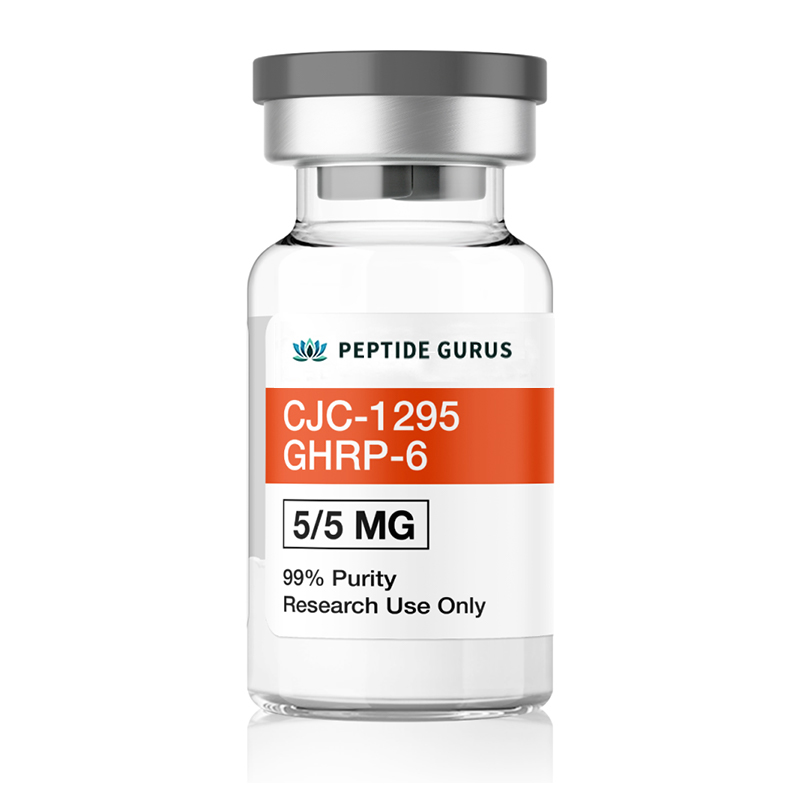
CJC-1295CJC-1295 является синтетическим аналогом гормона, высвобождающего гормон роста (GHRH), и связывается с рецептором GHRH в передней доле гипофиза. он хорошо известен своей способностью сохранять физиологическую пульсирующую секрецию гормона роста, одновременно повышая уровень гормона роста. GHRP-6 является асинтетическим аналогом грелина и связывается с рецептором, стимулирующим секрецию гормона роста.
Исследования показали, что в сочетании эти два пептида работают синергетически, существенно повышая уровень гормона роста. GHRP-6 действует как базовый бустер GH, повышая заданный уровень GH, другими словами, GHRP-6 гарантирует, что самый низкий уровень, до которого падает GH, будет выше, чем в нормальных физиологических условиях. Затем CJc-1295 будет стимулировать высвобождение ГР пульсирующим образом, используя новый базовый уровень более высокого уровня, установленный GHRP-6, в качестве минимума и создавая пропорционально повышенные пики [1], [2].
В качестве дополнительного преимущества исследования показали, что GHRP-6 стимулирует аппетит и улучшает качество сна. Увеличение потребления пищи позволяет лучше использовать повышенные уровни гормона роста, поскольку появляется больше сырья, из которого можно наращивать мышцы, улучшать плотность костей и способствовать росту. Сон — это время, в течение которого животные наиболее восприимчивы к воздействию ГР, и, таким образом, улучшение качества сна помогает гарантировать, что ГР оказывает наибольшее влияние на такие функции, как заживление ран и регенерация иммунной системы. Оба пептида также способствуют улучшению заживления ран и защите нервной ткани[3]-[6].Об автореВышеупомянутая литература была исследована, отредактирована и систематизирована доктором Э. Логаном, доктором медицинских наук. Доктор Э. Логан имеет докторскую степень Медицинской школы Университета Кейс Вестерн Резерв и степень бакалавра в области молекулярной биологии.Научный журналАвторMárta Korbonits graduated in Medicine in Budapest and undertook her early clinicaltraining at the Internal Medicine Department of the Postgraduate Medical School,Budapest. She joined the Department of Endocrinology at St. Bartholomew’s Hospitalunder the mentorship of Professors Ashley Grossman and Michael Besser. Her MD andlater PhD studies contributed to the understanding of the effects of growth hormone secretagogues on hypothalamic hormone release and the nature and causes of pituitary tumorigenesis. She was awarded an MRC Clinician Scientist Fellowship and commenced studies that produced novel insights into ghrelin physiology and genetics. Her finding srelated to the regulation of the metabolic enzyme AMPK by ghrelin, cannabinoid andglucocorticoid opened a new aspect of hormonal requlation of metabolism. In 2008. MartaKorbonits was promoted to Professor of Endocrinology and Metabolism and since 2012has led the Centre of Endocrinology at Barts and the London School of Medicine. in 2016, Márta Korbonits was appointed a Deputy Head of the William Harvey ResearchInstitute. Professor Korbonits continues to integrate human studies alongside withlaboratory-based research and has pioneered several projects in translational medicine.
Márta Korbonits is being referenced as one of the leading scientists involved in theresearch and development of GHRP-6. In no way is this doctor/scientist endorsing oradvocating the purchase, sale, or use of this product for any reason. There is no affiliationor relationship, implied or otherwise, between PEPTIDE GURUS and this doctor. Thepurpose of citing the doctor is to acknowledge, recoanize, and credit the exhaustiveresearch and development efforts conducted by the scientists studying this peptide. MártaKorbonits is listed ini[7] under the referenced citations.СсылкиЦитаты[1]M. lonescu and L. A. Frohman, “Pulsatile secretion of growth hormone (GH)persists during continuous stimulation by CJC-1295, a long-acting GH-releasinghormone analog,”J.Clin.Endocrinol. Metab., vol.91, no.12,pp.4792-4797, Dec2006.[PubMed]
[2]S.L.Teichman, A. Neale, B.Lawrence, C.Gagnon, J.-P. Castaigne, and L. AFrohman, “Prolonged stimulation of growth hormone (GH) and insulin-like growthfactor l secretion by CJC-1295, a long-acting analog of GH-releasing hormone, inhealthy adults,”J.Clin.Endocrinol. Metab., vol. 91,no.3, pp.799-805, Mar. 2006[PubMed]
[3] Y. Mendoza Marí et al., “Growth Hormone-Releasing Peptide 6 Enhances theHealing Process and lmproves the Esthetic Outcome of the Wounds,” PlasticSurgery International, 2016.[Online]. Available:https://www.hindawi.com/journals/psi/2016/4361702/.[Accessed: 23-May-2019]
[4]M. Fernández-Mayola et al., “Growth hormone-releasing peptide 6 preventscutaneous hypertrophic scarring: early mechanistic data from a proteome study.Int. Wound J., vol.15,no.4, pp.538-546,Aug.2018.[PubMed]
[5]H.-J. Huang et al., “The protective effects of Ghrelin/GHSR on hippocampal neurogenesis in CUMS mice,” Neuropharmacology, May 2019.[PubMed]
[6]N. Subirós et al..“Assessment of dose-effect and therapeutic time window inpreclinical studies of rhEGF and GHRP-6 coadministration for stroke therapy,Neurol. Res., vol.38, no.3, pp.187-195, Mar. 2016.[PubMed]
7]Korbonits, Marta, and Ashley B.Grossman.“Growth Hormone-ReleasingPeptide and lts Analogues.” Trends in Endocrinology& Metabolism, vol. 6, no. 2,Mar.1995, pp.43-49 [PubMed]
ALL ARTICLES AND PRODUCT INFORMATION PROVIDED ON THIS WEBSITE AREFOR INFORMATIONAL AND EDUCATIONAL PURPOSES ONLY.
The products offered on this website are furnished for in-vitro studies only. In-vitro studies(Latin: in glass) are performed outside of the body. These products are not medicines ordrugs and have not been approved by the FDA to prevent, treat or cure any medicalcondition, ailment or disease. Bodily introduction of any kind into humans or animals isstrictly forbidden by law.