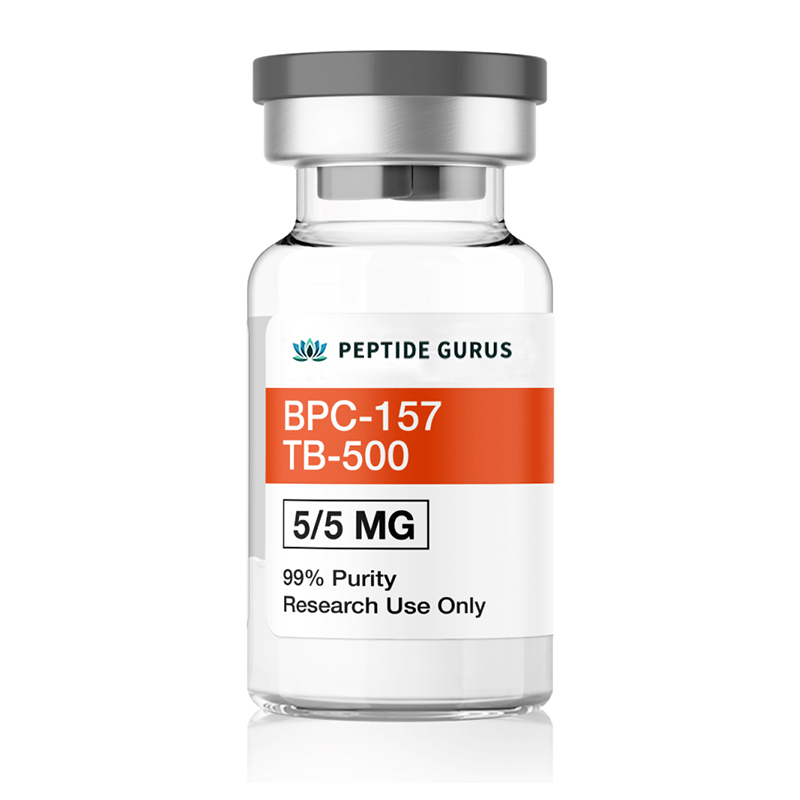
PotentielBPC-157 et TB-500Synergy dans WoundRepairLa recherche révèle que le BPC-157 et le TB-500, qui aident tous deux à stimuler la cicatrisation des plaies différentes voies biochimiques, peuvent avoir des effets synergiques lorsqu'ils sont combinés ensemble.Migration cellulaireUne cicatrisation réussie dépend des fibroblastes, qui régulent la production de matrice extracellulaire, ainsi que des cellules du système immunitaire. Pour que ces cellules fassent leur travail, elles ne se déplacent pas à l'emplacement de la blessure. Ce mouvement, appelé migration, dépend fortement de l'actine protéique. Le BPC-157 et le TB-500 sont tous deux importants dans la régulation de l'actine que le BPC-157 fonctionne au niveau du gène pour augmenter la production d'actine [1] .TB-500, une protéine d'actine, aide à séquestrer l'actine dans les zones où elle est la plus utile pour les régimes de construction de l'actine pour permettre le mouvement cellulaire [2]. Ensemble, le BPC-157 et le TB-500 sont en train d'augmenter pour augmenter la quantité et la fonction de l'actine et ainsi augmenter le taux de fibroblastes et les cellules du système immunitaire migrent vers des zones de blessures.La grande image des objets de croissanceTB-500 et BPC-157 interagissent avec l'hormone de croissance dans le processus de guérison. Le BPC-157 a augmenté l'expression des récepteurs des hormones de croissance sur les fibroblastes, augmentant la thélongevité de ces cellules et donc leur capacité à favoriser la régénération des tissus mous [3]. Avec TB-500 à bord, les récepteurs des hormones de croissance supplémentaires ne seront pas gaspillés car les fibroblastes auront des réserves adéquates d'actine pour utiliser leur durée de vie allongée.À propos de l'auteurLa littérature ci-dessus a été étudiée, édité et organisée par le Dr E. Logan, M.D. Le Dr Elogan est titulaire d'un doctorat de la Case Western Reserve University School ofmedicine et d'un B.S. en biologie moléculaire.Auteur de Journa scientifiqueAllan L. Goldstein, MD, Allan L. Goldstein is professor and Catharine B. & WiliamMcCormick Chair of the department of Biochemistry and Molecular Biology at TheGeorge Washington University School of Medicine and Health Sciences, where he hasserved since 1978. Thymosins were discovered in the mid 1960’s, when Allan Goldsteinfrom the Laboratory of Abraham White at the Albert Einstein College of Medicine in NewYork studied the role of the thymus in development of the vertebrate immune system. Heis a world-renowned authority on the thymus gland and the workings of the immunesystem, and co-discoverer of the thymosins. Dr. Goldstein is the author of over 400 scientific articles in professional journals, the inventor on more than 15 U.S. Patents, andthe editor of several books in the fields of biochemistry, biomedicine, immunology andneuro-science. He is on the editorial boards of numerous scientific and medical journalsand has been a consultant to many re-search organizations in industry and government;,co-founder of The institute for Advanced Studies in Aging and Geriatric Medicine, a non-profit research and educational institute; a member of the Board of Trustees of the AlbertSabin Vaccine Institute, and serves as the Chairman of the Board of Regene Rx Biopharmaceuticals. Dr. Goldstein received his B.S. from Wagner College in 1959 and hisM.S. and Ph.D. from Rutgers University in 1964. He served as a faculty member of theAlbert Einstein College of Medicine from 1964 to 1972, and moved to the University ofTexas Medical Branch in Galveston in 1972 as professor and director of the division of Biochemistry.
Allan L. Goldstein, MD is being referenced as one of the leading scientists involved in theresearch and development of TB-500 and other Thymosins. In no way is thisdoctor/scientist endorsing or advocating the purchase, sale, or use of this product for anyreason. There is no affiliation or relationship, implied or otherwise, between PeptideSciences and this doctor. The purpose of citing the doctor is to acknowledge, recognize.and credit the exhaustive research and development efforts conducted by the scientistsstudying this peptide. Dr. Goldstein is listed in [5]under the referenced citations.Ressources1.C.-H. Chang, W.-C. Tsai, M.-S. Lin, Y-H. Hsu, and J.-H. S. Pang, “The promotingeffect of pentadecapeptide BPC 157 on tendon healing involves tendon outgrowth,cell survival, and cell migration,”J.Appl. Physiol., vol. 110, no.3, pp.774-780, Oct[Physiology.org]
2.J. Kim and Y. Jung, “Potential Role of Thymosin Beta 4 in Liver Fibrosis,” Int. J.Mol. Sci., vol.16,no.5,pp.10624-10635,May 2015.[NCBI]
3.C.-H. Chang, W.-C. Tsai, Y.-H. Hsu, and J.-H.S.Pang,“Pentadecapeptide BPC157 enhances the growth hormone receptor expression in tendon fibroblasts,” Mol.Basel Switz.,vol.19,no.11,pp.19066-19077, NOV. 2014.[NCBI]
4.Song, Ran & Choi, Hyun & Yang, Hyung-In & Yoo, Myung & Park, Yong-Beom &Kim, Kyoung.(2012).Association between serum thymosin B4 levels of rheumatoidarthritis patients and disease activity and response to therapy. Clinicalrheumatology.31.1253-8.10.1007/s10067-012-2011-7.[Research Gate]
5.Philp, D., et al. “Thymosin β4 Promotes Angiogenesis, Wound Healing, and HairFollicle Development.”Mechanisms ofAgeing and Development, vol. 125, no. 2Feb.2004,pp.113-115,10.1016/i.mad.2003.11.005.[PubMed]
ALL ARTICLES AND PRODUCT INFORMATION PROVIDED ON THIS WEBSITE AREFOR INFORMATIONAL AND EDUCATIONAL PURPOSES ONLY.
The products offered on this website are furnished for in-vitro studies only. in-vitro studies(Latin: in glass) are performed outside of the body. These products are not medicines ordrugs and have not been approved by the FDA to prevent, treat or cure any medicalcondition, ailment or disease. Bodily introduction of any kind into humans or animals isstrictly forbidden by law.