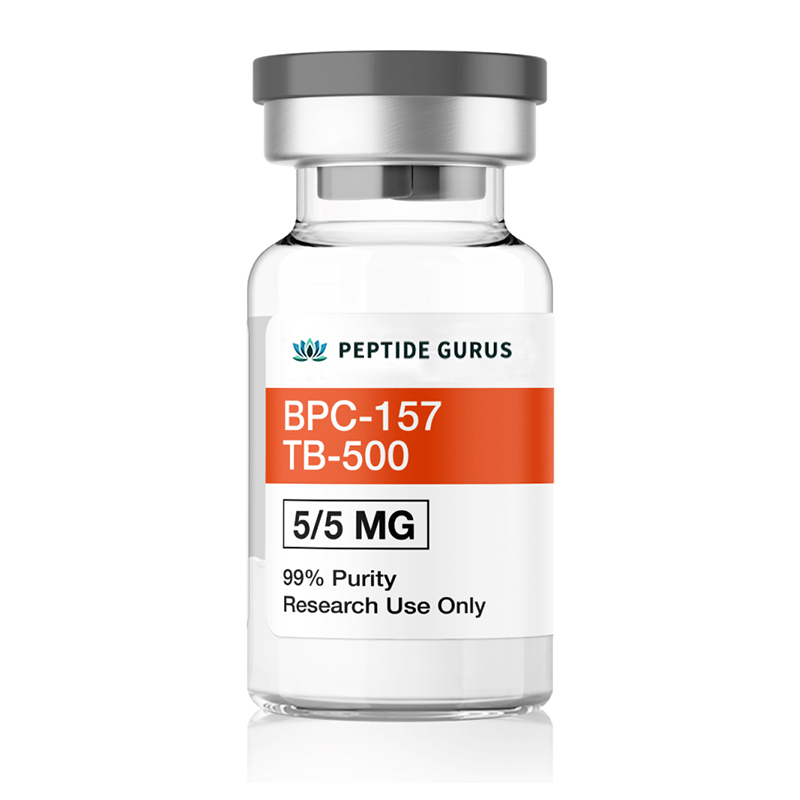
PotenzialeBPC-157 e TB-500Synergy in WoundRepairLa ricerca rivela che BPC-157 e TB-500, che aiutano entrambi a stimolare la guarigione delle ferite diverse percorsi biochimici, possono avere effetti sinergici quando combinati insieme.Migrazione cellulareLa guarigione della ferita di successo dipende dai fibroblasti, che regolano la produzione di matrice extracellulare, nonché dalle cellule del sistema immunitario. Affinché queste cellule svolgano il loro lavoro, hanno mantenuto di spostarsi nella posizione della lesione. Questo movimento, chiamato migrazione, dipende fortemente dall'actina proteica. Sia BPC-157 che TB-500 sono importanti nella regolazione dell'actina BPC-157 funziona a livello del gene per aumentare la produzione di actina [1] .TB-500, una proteina di actinbinding, aiuta a sequestrare l'actina nelle aree in cui è molto utile per costruire filement dall'actina per consentire il movimento cellulare [2]. Insieme, BPC-157 e TB-500 Worksernergisticamente per aumentare la quantità e la funzione dell'actina e quindi aumentare il tasso di fibroblasti e cellule del sistema immunitario migrano verso aree di lesione.Il grande immagine dellustrante è un armone di crescitaSia TB-500 che BPC-157 interagiscono con l'ormone della crescita nel processo di guarigione. BPC-157escreas l'espressione dei recettori dell'ormone della crescita sui fibroblasti, aumentando la thelongevità di queste cellule e quindi la loro capacità di promuovere la rigenerazione dei tessuti molli [3]. WITTB-500 a bordo, i recettori dell'ormone della crescita extra non andranno sprecati perché i fibroblasti avranno adeguati negozi di actina per sfruttare la loro durata allungata per la vita. Binding TB5-00, BPC-157, collagene e un secreto dell'ormone della crescita è un vero e proprio fireway per aumentare i tassi di guarigione delle ferite e di essere a causa di una giornata di trattamento standard.Sull'autoreLa letteratura di cui sopra è stata studiata, curata e organizzata dal Dr. E. Logan, M.D. Dr. Elogan ha conseguito un dottorato presso la Case Western Reserve University School of Medicine e un B.S. in biologia molecolare.Autore di Journa scientificaAllan L. Goldstein, MD, Allan L. Goldstein is professor and Catharine B. & WiliamMcCormick Chair of the department of Biochemistry and Molecular Biology at TheGeorge Washington University School of Medicine and Health Sciences, where he hasserved since 1978. Thymosins were discovered in the mid 1960’s, when Allan Goldsteinfrom the Laboratory of Abraham White at the Albert Einstein College of Medicine in NewYork studied the role of the thymus in development of the vertebrate immune system. Heis a world-renowned authority on the thymus gland and the workings of the immunesystem, and co-discoverer of the thymosins. Dr. Goldstein is the author of over 400 scientific articles in professional journals, the inventor on more than 15 U.S. Patents, andthe editor of several books in the fields of biochemistry, biomedicine, immunology andneuro-science. He is on the editorial boards of numerous scientific and medical journalsand has been a consultant to many re-search organizations in industry and government;,co-founder of The institute for Advanced Studies in Aging and Geriatric Medicine, a non-profit research and educational institute; a member of the Board of Trustees of the AlbertSabin Vaccine Institute, and serves as the Chairman of the Board of Regene Rx Biopharmaceuticals. Dr. Goldstein received his B.S. from Wagner College in 1959 and hisM.S. and Ph.D. from Rutgers University in 1964. He served as a faculty member of theAlbert Einstein College of Medicine from 1964 to 1972, and moved to the University ofTexas Medical Branch in Galveston in 1972 as professor and director of the division of Biochemistry.
Allan L. Goldstein, MD is being referenced as one of the leading scientists involved in theresearch and development of TB-500 and other Thymosins. In no way is thisdoctor/scientist endorsing or advocating the purchase, sale, or use of this product for anyreason. There is no affiliation or relationship, implied or otherwise, between PeptideSciences and this doctor. The purpose of citing the doctor is to acknowledge, recognize.and credit the exhaustive research and development efforts conducted by the scientistsstudying this peptide. Dr. Goldstein is listed in [5]under the referenced citations.Risorse1.C.-H. Chang, W.-C. Tsai, M.-S. Lin, Y-H. Hsu, and J.-H. S. Pang, “The promotingeffect of pentadecapeptide BPC 157 on tendon healing involves tendon outgrowth,cell survival, and cell migration,”J.Appl. Physiol., vol. 110, no.3, pp.774-780, Oct[Physiology.org]
2.J. Kim and Y. Jung, “Potential Role of Thymosin Beta 4 in Liver Fibrosis,” Int. J.Mol. Sci., vol.16,no.5,pp.10624-10635,May 2015.[NCBI]
3.C.-H. Chang, W.-C. Tsai, Y.-H. Hsu, and J.-H.S.Pang,“Pentadecapeptide BPC157 enhances the growth hormone receptor expression in tendon fibroblasts,” Mol.Basel Switz.,vol.19,no.11,pp.19066-19077, NOV. 2014.[NCBI]
4.Song, Ran & Choi, Hyun & Yang, Hyung-In & Yoo, Myung & Park, Yong-Beom &Kim, Kyoung.(2012).Association between serum thymosin B4 levels of rheumatoidarthritis patients and disease activity and response to therapy. Clinicalrheumatology.31.1253-8.10.1007/s10067-012-2011-7.[Research Gate]
5.Philp, D., et al. “Thymosin β4 Promotes Angiogenesis, Wound Healing, and HairFollicle Development.”Mechanisms ofAgeing and Development, vol. 125, no. 2Feb.2004,pp.113-115,10.1016/i.mad.2003.11.005.[PubMed]
ALL ARTICLES AND PRODUCT INFORMATION PROVIDED ON THIS WEBSITE AREFOR INFORMATIONAL AND EDUCATIONAL PURPOSES ONLY.
The products offered on this website are furnished for in-vitro studies only. in-vitro studies(Latin: in glass) are performed outside of the body. These products are not medicines ordrugs and have not been approved by the FDA to prevent, treat or cure any medicalcondition, ailment or disease. Bodily introduction of any kind into humans or animals isstrictly forbidden by law.