

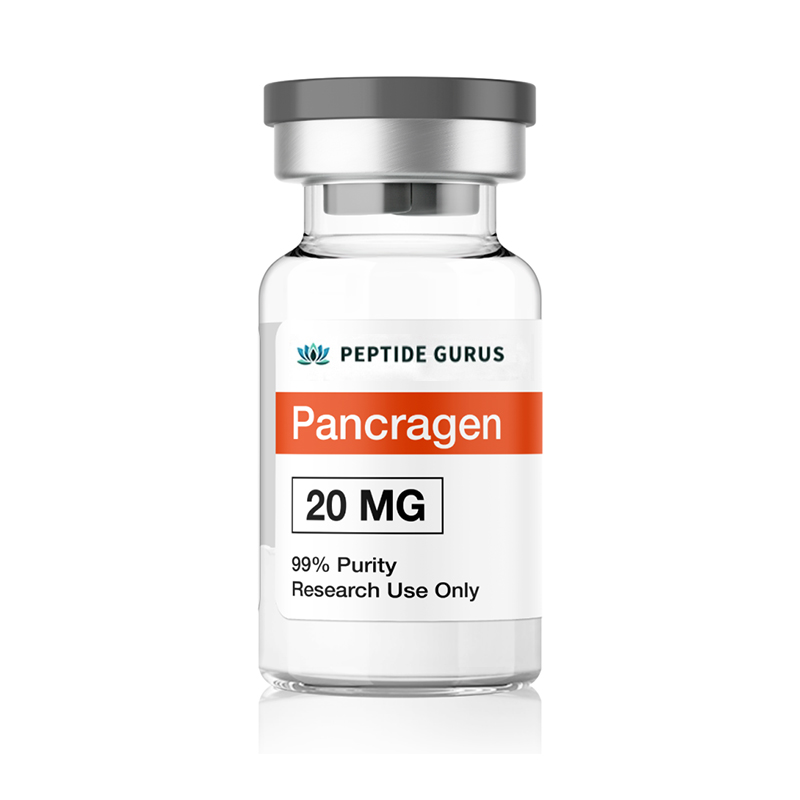

• Pancragen (Bioregulator) peptide and pancreatic function improvement
Pancragen(バイオレギュレーター)ペプチド
X
Pancragen(バイオレギュレーター)ペプチド

Pancragen 20mg(Bioregulator)

カテゴリ:, ,

注文するには連絡先
今すぐメールでご注文をし、1対1のサポートでご注文いたします。在庫が限られています!Zelle、CashApp、Venmo、銀行振込、暗号通貨もご利用いただけます。
細菌水

遊離(1)30 mlの細菌性水
資格のある注文があります500米ドル. (カプセル製品、化粧品ペプチド、プロモーションコード、出荷を除く)

パンクラゲンは、膵臓に主要な影響を与える天然に存在するテトラペプチドバイオリーグレーターです。パンクラゲンの研究は、血糖の制御、膵臓の内分泌機能の改善、メラトニンの発現を調節し、メタボリックシンドロームの発生率と大きさを減らすのに役立つことを示しています。それは研究されており、糖尿病の治療と老化の代謝効果の両方に興味があります。膵臓は、膵臓のアンチエイジングペプチドと考えることができます。
製品の使用:この製品は、研究化学物質としてのみ意図されています。この指定により、in vitroテストと実験室の実験のために、研究化学物質を厳密に使用することができます。このウェブサイトで利用可能なすべての製品情報は、教育目的のみを目的としています。あらゆる種類の人間や動物への身体導入は、法律によって厳密に禁じられています。この製品は、認可された資格のある専門家によってのみ処理される必要があります。この製品は薬物、食品、または化粧品ではなく、薬物、食品、化粧品として誤ってブランド化されたり、誤用されたり、誤ったりしたりすることはない場合があります。

パンクラゲン

パンクラゲンは、名前が示すように、膵臓に主要な影響を与える自然に存在するテトラペプチドバイオリーグレーターです。 DNAベースのパンクラゲン検査と混同しないように、パンクラゲンは血糖を制御し、膵臓の内分泌機能を改善し、メラトニン発現を調節し、メタボリックシンドロームの発生率と大きさを減らすことが示されています。それは調査されており、糖尿病の治療と老化の代謝効果の両方に興味があります。ある程度、膵臓は膵臓のアンチエイジングペプチドと考えることができます。

パンクラゲン構造

アミノ酸配列:lys-glu-asp-trp(kedw)分子式:c26h36n6o9分子量:576.25 g/molPubchem cid: 68452887 同義語:Schembl5491754Moleculeソース:ペプドロー

パンクラゲンと老化

膵臓細胞の研究は、パンクラゲンがランゲルハンス細胞の腺房と島の成長を制御する多くの分化因子の発現を刺激することを示しています。後者はインスリンとグルカゴンの原因です[1]。これはアンチエイジング効果のように思えるかもしれませんが、成長と分化の改善の回復が若くて健康な組織の特徴であることを明確にする必要があります。特に古い組織でこれらのパラメーターを改善することは、基本的にアンチエイジング効果です。 Pancragenの残りの部分を通して、アンチエイジングペプチドとしての分類の追加の理由が明らかになります。特に、遺伝子発現を改善するためにDNAのエピジェネティックな調節を変更する能力は、パンクラゲンがDNAの時計を元に戻し、若者に合わせて機能を促進できるという最も明確な兆候の1つです。

膵臓および代謝障害

Further supporting the idea that Pancragen is an anti-aging peptide are its effects on metabolic disorders. Research shows that metabolic dysregulation in older people is at least partially caused by changes in melatonin secretion during sleep. This melatonin deficiency appears to be caused by changes in insulin levels, suggesting that loss of insulin function, both in disease and as a result of old age, may be responsible for changes in melatonin secretion, which is then responsible for some of the other symptoms of metabolic syndrome[2]. Based on the above line of thought, it stands to reason that administration of Pancragen, which helps to normalize insulin secretion, could further reduce symptoms of metabolic syndrome by normalizing melatonin secretion. In fact, this is precisely what research reveals. Administration of Pancragen decreases glucose levels but also reduces plasma concentrations of insulin as well as the insulin resistance index which are strong indications that Pancragen is having a direct effect on melatonin signaling[2]. Both exogenous and endogenous melatonin inhibit the pathophysiological mechanisms of metabolic syndrome and normalize metabolism[3]. Research shows that melatonin receptors exist in the pancrease where they serve to modulate insulin and glucagon signaling in a diurnal (daylight-sensitive) fashion[4]. There is a lot of new research focusing on how disruptions in melatonin signaling are linked to the development of type 2 diabetes and metabolic syndrome. If melatonin affects the pancreas, then is stands to reason that there is likely a feedback mechanism by which glucagon and insulin signal to the pineal gland whether to increase or decrease melatonin release. In fact, this feedback loop exists and, in type 2 diabetes, appears to be responsible for the additional metabolic effects that arise in this version of the disease that are less common in type 1 diabetes. This would explain why Pancragen’s ability to regulate insulin secretion of the pancreas also has beneficial effects on other symptoms of metabolic syndrome.Pancragen Figureソース:パブ

膵臓と糖尿病

Of course, the most obvious use for Pancragen is in the treatment of diabetes, hyperinsulinemia, and elevated blood glucose levels. Research in rhesus monkeys comparing Pancragen to glimepiride (a widely used drug for lowering blood sugar) reveals that while both compounds can reduce blood sugar levels to normal baselines, only Pancragen normalizes insulin levels and C-peptide levels[5], [6]. This would suggest that Pancragen is having a more physiologic effect, striking at the very heart of what causes elevated blood sugar and correcting the problem at a more fundamental level. Research in old monkeys shows that Pancragen normalizes plasma insulin, C-peptide, and glucose levels within 10 days and that the effect lasts, at least partially, for as long as 3 weeks[7], [8]. This suggests that Pancragen might be useful in restoring pancreatic function in elderly individuals or maintaining it as we age. This can help to normalize the metabolic system and reduce the impact of everything from osteoporosis to dementia. Additional research in cell cultures shows that Pancragen increases the expression of matrix metalloproteinases MMP2 and MMP9. It also increases the expression of serotonin, glycoprotein CD79alpha, and the anti-apoptotic protein MCl1 while decreasing levels of the pro-apoptotic protein p53. Additionally, levels of proliferation markers PCNA and Ki67 are increased. Vasili Ashapkin, author of the textbook植物のDNAメチル化ウラジミール・ハビンソンとの協力者は、これらの発見は、膵島細胞の分化と機能性の増加に関連するシグナル伝達分子の発現を活性化することを集合的に示していることを指摘している[9]、[10]。これらの効果は、DNA発現や凝縮パターンの直接的な変化などの広範な機能メカニズムによってのみ説明できます。言い換えれば、PancragenはDNA内の非常に基本的なレベルで働いている可能性があり、複数の遺伝子の発現を変化させます。

パンクラゲンと血管系

One of the most serious consequences of diabetes is on the function of small blood vessels called capillaries. Elevated glucose levels cause these capillaries to first become leak and then to die off as the cells that make them up, called endothelial cells, become dysfunctional and then die. Many of the long-term consequences of diabetes like heart disease, kidney disease, erectile dysfunction, and loss of limb result from damage to and loss of capillaries. Research on Pancragen shows that it helps to normalize the adhesion of mesenteric capillary endothelium[11]. These findings suggest that Pancragen could protect the endothelium from some of the effects of diabetes, thus helping to stave off long-term consequences of the disease.

パンクラゲンと血管系

糖尿病の最も深刻な結果の1つは、毛細血管と呼ばれる小さな血管の機能です。グルコースレベルの上昇により、これらの毛細血管は最初に漏れになり、その後、内皮細胞と呼ばれる細胞が機能不全になり、死ぬにつれて死ぬようになります。心臓病、腎臓病、勃起不全、四肢の喪失などの糖尿病の長期的な結果の多くは、毛細血管の損傷と喪失に起因します。

記事著者

上記の文献は、M.D。ケースウエスタンリザーブ大学医学部とB.S.分子生物学で。

Scientific Journalの著者

ウラジミール・ハビンソン老年学と老年学の国際協会の欧州地域の教授であり、ヨーロッパ地域の会長です。のメンバー医学科学のロシア語とウクライナのアカデミー;ロシア州政府政府の保健委員会の主要老年学者。聖ペテルブルク生物調節および老年学研究所のディレクター。老年学会の副会長ロシア科学アカデミー;セントペテルブルクの老年医学および老年科学老年科学部長。医療サービス大佐(ロシア、ソ連)、退職。VladimirKhavinsonは、新しいクラスの発見、実験、臨床研究で知られていますペプチド生体調節因子と生体育成ペプチド療法の開発。彼は、老化のメカニズムの調節におけるペプチドの役割を研究することに従事しています。彼の主な行動分野は、新しいペプチドの設計、臨床前、臨床研究ですゼロゲロテクター. A 40-year-long investigation resulted in a multitude of methods of application of peptide bioregulators to slow down the process of ageing and increase human life span. Six peptide-based pharmaceuticals and 64 peptide food supplements have been introduced into clinical practice by V. Khavinson. He is an author of 196 patents (Russian and international) as well as of 775 scientific publications.His major achievements are presented in two books: “Peptides and Ageing” (NEL, 2002)and “Gerontological aspects of genome peptide regulation” (Karger AG, 2005).Vladimir Khavinson introduced scientific specialty “Gerontology and Geriatrics” in the Russian Federation on the governmental level. Academic Council headed by V. Khavinson has oversighted over 200 Ph.D. and Doctorate theses from many different countries. Prof. Vladimir Khavinson is being referenced as one of the leading scientists involved in the research and development of Pancragen. In no way is this doctor/scientist endorsing or advocating the purchase, sale, or use of this product for any reason. There is no affiliation or relationship, implied or otherwise, between
ペプチドグルそしてこの医者。医師を引用する目的は、このペプチドを研究している科学者が実施した徹底的な研究開発努力を認め、認識し、称賛することです。

参照された引用

    V. K. Khavinsonet al., “Effects of pancragen on the differentiation of pancreatic cells during their ageing,”Bull. Exp. Biol. Med., vol. 154, no. 4, pp. 501–504, Feb. 2013, doi: 10.1007/s10517-013-1987-6. O. V. Korkushko, V. K. Khavinson, V. B. Shatilo, I. A. Antonyk-Sheglova, and E. V. Bondarenko, “Prospects of using pancragen for correction of metabolic disorders in elderly people,”Bull. Exp. Biol. Med., vol. 151, no. 4, pp. 454–456, Aug. 2011, doi: 10.1007/s10517-011-1354-4. S. I. Rapoport, A. I. Molchanov, V. A. Golichenkov, O. V. Burlakova, E. S. Suprunenko, and E. S. Savchenko, “[Metabolic syndrome and melatonin],”Klin. Med. (Mosk.), vol. 91, no. 11, pp. 8–14, 2013. E. Peschke, I. Bähr, and E. Mühlbauer, “Melatonin and pancreatic islets: interrelationships between melatonin, insulin and glucagon,”Int. J. Mol. Sci., vol. 14, no. 4, pp. 6981–7015, Mar. 2013, doi: 10.3390/ijms14046981. N. D. Goncharova, L. G. Ivanova, T. E. Oganyan, A. A. Vengerin, and V. K. Khavinson, “[Correction of impaired glucose tolerance using tetrapeptide (Pancragen) in old female rhesus monkeys],”Adv. Gerontol. Uspekhi Gerontol., vol. 28, no. 3, pp. 579–585, 2015. V. K. Khavinson, M. M.-G. Gapparov, N. E. Sharanova, A. V. Vasilyev, and G. A. Ryzhak, “Study of biological activity of Lys-Glu-Asp-Trp-NH2 endogenous tetrapeptide,”Bull. Exp. Biol. Med., vol. 149, no. 3, pp. 351–353, Sep. 2010, doi: 10.1007/s10517-010-0944-x. N. D. Goncharova, L. G. Ivanova, T. É. Oganian, A. A. Vengerin, and V. K. Khavinson, “[Impact of tetrapeptide pancragen on endocrine function of the pancreas in old monkeys],”Adv. Gerontol. Uspekhi Gerontol., vol. 27, no. 4, pp. 662–667, 2014. I. M. Kvetnoi, A. P. Ryzhak, I. N. Kostyuchek, and Y. A. Tafeev, “Effect of tetrapeptide pancragene on functional morphology of the pancreas in rats with experimental diabetes mellitus,”Bull. Exp. Biol. Med., vol. 143, no. 3, pp. 368–371, Mar. 2007, doi: 10.1007/s10517-007-0114-y. V. K. Khavinsonet al., “[Tetrapeptide stimulates functional activity of the pancreatic cells in aging],”Adv. Gerontol. Uspekhi Gerontol., vol. 25, no. 4, pp. 680–684, 2012. V. V. Ashapkin, N. S. Linkova, V. K. Khavinson, and B. F. Vanyushin, “Epigenetic mechanisms of peptidergic regulation of gene expression during aging of human cells,”Biochem. Biokhimiia, vol. 80, no. 3, pp. 310–322, Mar. 2015, doi: 10.1134/S0006297915030062. V. K. Khavinson, N. A. Gavrisheva, V. V. Malinin, S. G. Chefu, and E. L. Trofimov, “Effect of pancragen on blood glucose level, capillary permeability and adhesion in rats with experimental diabetes mellitus,”Bull. Exp. Biol. Med., vol. 144, no. 4, pp. 559–562, Oct. 2007, doi: 10.1007/s10517-007-0377-3.
このウェブサイトで提供されるすべての記事と製品情報は、情報および教育目的のみを目的としています。このウェブサイトで提供される製品は、ビトロ内の研究のためにのみ提供されています。 in-vitro研究(ラテン語:ガラス)は体の外側で行われます。これらの製品は薬や薬ではなく、病状、病気、病気を予防、治療、治療するためにFDAによって承認されていません。あらゆる種類の人間や動物への身体導入は、法律によって厳密に禁じられています。

お問い合わせをリクエストしてください

私たちについて

Peptidegurusは、アメリカ製の研究ペプチドの大手サプライヤーであり、競争力のある価格で最高品質の製品を提供しています。卓越性と顧客サービスに重点を置いて、彼らはグローバルな配送で安全で便利な注文プロセスを保証します。

見積もりをリクエストしてください

  • ペプチドグル
  • info@peptidegurus.com
  • グレンデール、それは、アメリカ
  • 接触

    お問い合わせをリクエストしてください